
House Finance committee advances bill to create $300 million higher-education capital fund
Get AI-powered insights, summaries, and transcripts
Subscribe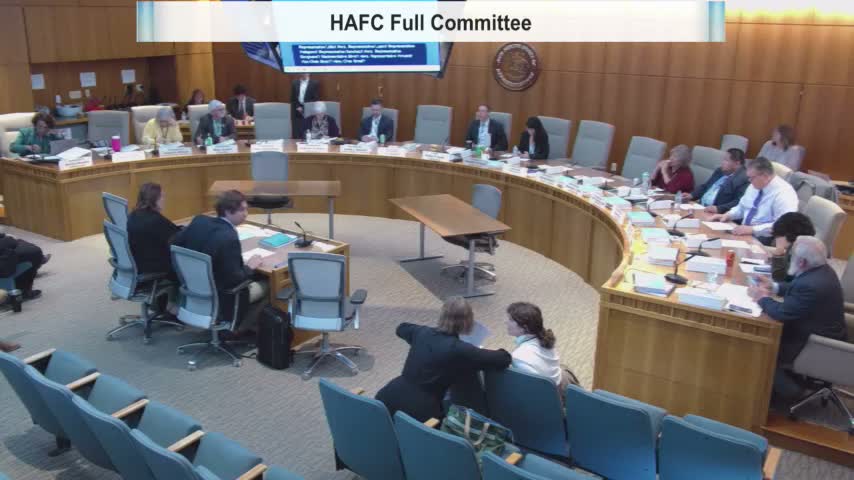
Summary
The House Finance Committee voted to give House Bill 8 a do-pass recommendation after adopting an amendment. The bill would transfer $300 million from the general fund into a major capital projects fund and sets initial priorities including $150 million for the UNM School of Medicine, $50 million for New Mexico State University and $100 million for student housing and student-life projects statewide.
The House Finance Committee on a committee voice vote advanced House Bill 8 after adopting an amendment that revised the bill's initial text. Sponsor Representative Gonzalez told the committee the bill would create and transfer $300,000,000 into a major capital projects fund and set initial funding priorities to address deferred needs across higher education.
Representative Connor Gonzalez, sponsor of House Bill 8, summarized the bill's priorities: "House bill 8 creates and transfers 300,000,000 to the major capitals project fund, and it sets priorities for 150,000,000 for the UNM School of Medicine, 50,000,000 for a multipurpose building at New Mexico State University, and 100,000,000 for student life and housing projects statewide." She said eligible projects and thresholds would be defined by the bill and implemented through the Higher Education Department.
The bill lays out matching requirements for different project types. Staff explained that instruction-in-general projects at four-year institutions that exceed $50,000,000 must provide a 25% match in the design phase; athletics projects above $50,000,000 require a 50% design-phase match and are not eligible for waivers; student-life and housing projects have no minimum threshold but generally require a 50% design-phase match. For two-year institutions, eligible projects are student life and housing and also require a 50% design-phase match.
On the waiver process, Representative Gonzalez said institutions may apply to the Higher Education Department for a waiver when they "cannot reasonably afford the match," and the department will promulgate rules specifying waiver procedures and selection criteria; staff added that any waiver recommended by the department must be approved by the legislature as part of an appropriations act or legislative appropriation.
Public testimony at the committee hearing was uniformly supportive. Mark Fedra, executive director of the New Mexico Council of University Presidents, said the fund responds to "critical need" for capital projects across the state's seven universities. Clayton Abbe of New Mexico State University urged lawmakers to consider student-focused needs such as housing and athletics facilities, and Vanessa Hocker, executive director for New Mexico's Independent Community Colleges, said the bill provides a new funding stream that could allow community colleges to develop student housing and free up general obligation bond capacity for other projects.
Members asked detailed questions about mechanics and priorities. Representative Pettigrew asked whether the $150,000,000 earmarked for the UNM medical school in the budget is contingent on passage of HB8; staff confirmed it is: without HB8 creating the fund and the $300,000,000 transfer, the $150,000,000 could not be moved to the medical school. Representative Brown pressed on graduation-rate eligibility rules and was told that UNM and NMSU both had 2023 graduation rates in the low 50s and that the bill includes an alternate eligibility path tied to recent-year improvement over a three-year average.
Vice Chair Dixon offered an amendment that struck language authorizing the transfer from the general fund and removed a short section of the bill (the committee handout described the specific lines). The vice chair's amendment was seconded by Representative Garrett and adopted by voice vote. Dixon then moved a do-pass recommendation on House Bill 8 as amended; Garrett seconded. Chair Small recorded Representative Pettigrew as voting in opposition and noted the motion carried.
The committee action is a do-pass recommendation; the bill will proceed through the legislative process for appropriation and any waiver approvals required in later appropriations measures. The sponsor and staff said the Higher Education Department will draft rules for waiver and application procedures and that specific projects will still need to come forward for legislative appropriation.
Quotes used in this article come from the committee hearing transcript and are attributed to speakers who testified or questioned the bill. Next procedural steps: the bill, as amended and recommended, will advance for consideration in the legislature and any appropriation or waiver would be finalized through the normal appropriations process.