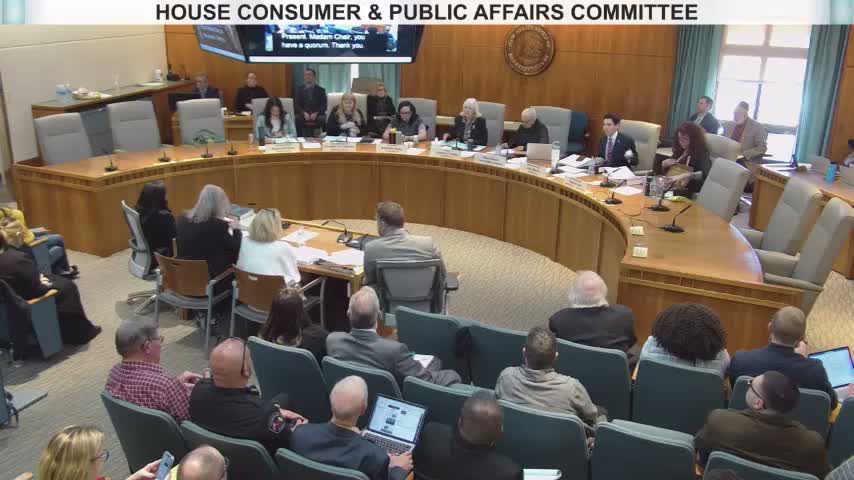
House committee adopts substitute to bar some juveniles adjudicated for firearm crimes from buying guns for 10 years
Loading...
Summary
The House Consumer and Public Affairs Committee advanced a substitute to House Bill 25 that would flag certain juvenile dispositions in the federal NICS system so that adults adjudicated as juveniles for felony‑level firearm use or possession would be denied firearms for 10 years after disposition. Supporters said it targets violent actors; opponents warned it undercuts juvenile‑justice principles.
The House Consumer and Public Affairs Committee on an early agenda took up House Bill 25, a measure that would prevent people who as juveniles were adjudicated for certain firearm crimes from legally obtaining firearms for 10 years after their juvenile disposition. Sponsors said the committee substitute clarifies the process and would not unseal juvenile court records.
Representative Kates, the bill’s sponsor, told the committee the substitute narrows the scope of the law to cases in which a juvenile’s unlawful possession or use of a firearm would be a felony if committed by an adult. “This takes away access to firearms for 10 years after disposition,” she said, describing the measure as a tool for law enforcement to address juvenile crime without increasing juvenile sentencing.
The sponsor and expert witnesses explained the mechanics: instead of unsealing records, courts would transmit a disposition flag to the National Instant Criminal Background Check System (NICS) that indicates whether an adult transferee is eligible to receive a firearm. Witnesses said the NICS entry would record only a yes/no eligibility indicator and a date for automatic removal 10 years after the juvenile disposition; details of the juvenile adjudication would remain sealed.
Law‑enforcement officials, juvenile justice leaders and representatives of the district attorneys association testified in support, saying the measure focuses limited enforcement tools on repeat or violent juvenile actors. “We’ve seen an influx of serious juvenile violent crime, specifically with guns,” Jeremy Stewart, police chief of Las Cruces, told the committee.
Civil‑liberties groups and public defenders opposed the bill. The ACLU and the New Mexico Criminal Defense Lawyers Association argued the proposal risks undermining the foundational principle that juvenile dispositions are not equivalent to adult convictions, pointing to NMSA 32A‑2‑18 and to the protections in the Children’s Code. Kim Chavez Cook of the public defender’s office said possession‑only offenses are often misdemeanors and should not trigger lasting adult disabilities.
Committee members pressed sponsors on several operational and legal questions, including who would transmit information to NICS (the Administrative Office of the Courts and the Department of Public Safety were cited), how the 10‑year clock is measured (from disposition), whether pardons would remove the NICS flag (yes, sponsors said), and whether the bill applies retroactively (sponsors said it would apply to future dispositions). Several members expressed concern about the difference between simple possession, possession on school grounds, and possession coupled with the use of a firearm in another felony.
The committee adopted the committee substitute for HB25 for further consideration. Sponsors said they will continue working with stakeholders to refine technical language before later committee stops.