Committee backs $8 million ask for Military Base Impact Fund to shore up local infrastructure
Loading...
Summary
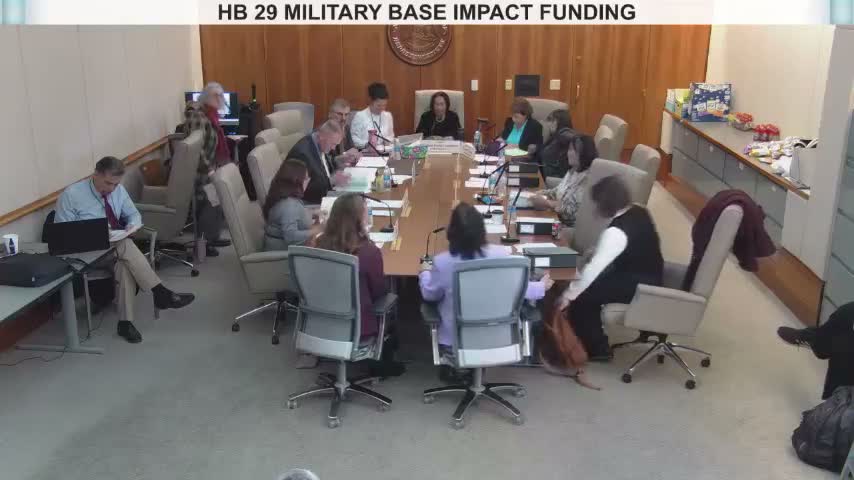
The House Labor, Veterans and Military Affairs Committee recommended a due pass for House Bill 29, which would appropriate $8 million to a Military Base Impact Fund to help host communities match federal grants for infrastructure projects that support nearby military installations.
Representative Debbie Sarnana presented House Bill 29 and said the proposal would fund the Military Base Impact Fund to help communities that host New Mexico’s military installations access federal grants and support mission readiness. "A small investment by the state can access hundreds of millions of dollars a year in infrastructure improvements that directly support military readiness," said expert witness Megan Cornett, who described the fund’s role in providing local matches for federal programs across agencies including the Department of Defense, Department of Energy and USDA.
Business and veterans groups supported the bill at the committee hearing. Bill Lee of the Greater Albuquerque Chamber of Commerce urged the committee to approve the appropriation, saying, "House Bill 29 will provide a vital $8,000,000 appropriation to the military base impact fund." Frank Smith, chair of the New Mexico Veterans and Military Families Caucus, said the funding targets critical infrastructure outside the installations — joint-use firing ranges, training centers, emergency-response and firefighting facilities — that the federal government does not fund. Megan Dela Rosa, executive director of the Kirtland Partnership, and local citizen Alan Martinez also testified in favor.
During questioning, committee members sought specifics about eligible projects. Cornett said phase one would focus on "mission readiness" or "defense critical infrastructure," naming electrical transmission upgrades, data centers pursued through public–private partnerships, and water treatment connections as examples. She cited Cannon Air Force Base’s request to connect to a city-operated water treatment plant as a use case where a long-term agreement could have the Air Force pay a municipality for services.
Cornett described the rulemaking timeline for the military base planning commission and said final grant rules were expected by July; the commission plans to include scoring factors such as verified installation need, endorsement by the installation commander and measures to ensure equitability among host communities. The committee made a motion for a due-pass recommendation and, after the chair asked for opposition and heard none, granted a due pass by voice vote. The motion was recorded in committee proceedings; no roll-call tally was recorded on the transcript.
The bill will move forward from the committee with the committee’s recommendation. The military base planning commission will finalize rules and grant criteria before awards are made.