
Lawmakers back $5.5M design funding and $150K study to address congestion, safety at US 60 / Loop 303
Get AI-powered insights, summaries, and transcripts
Subscribe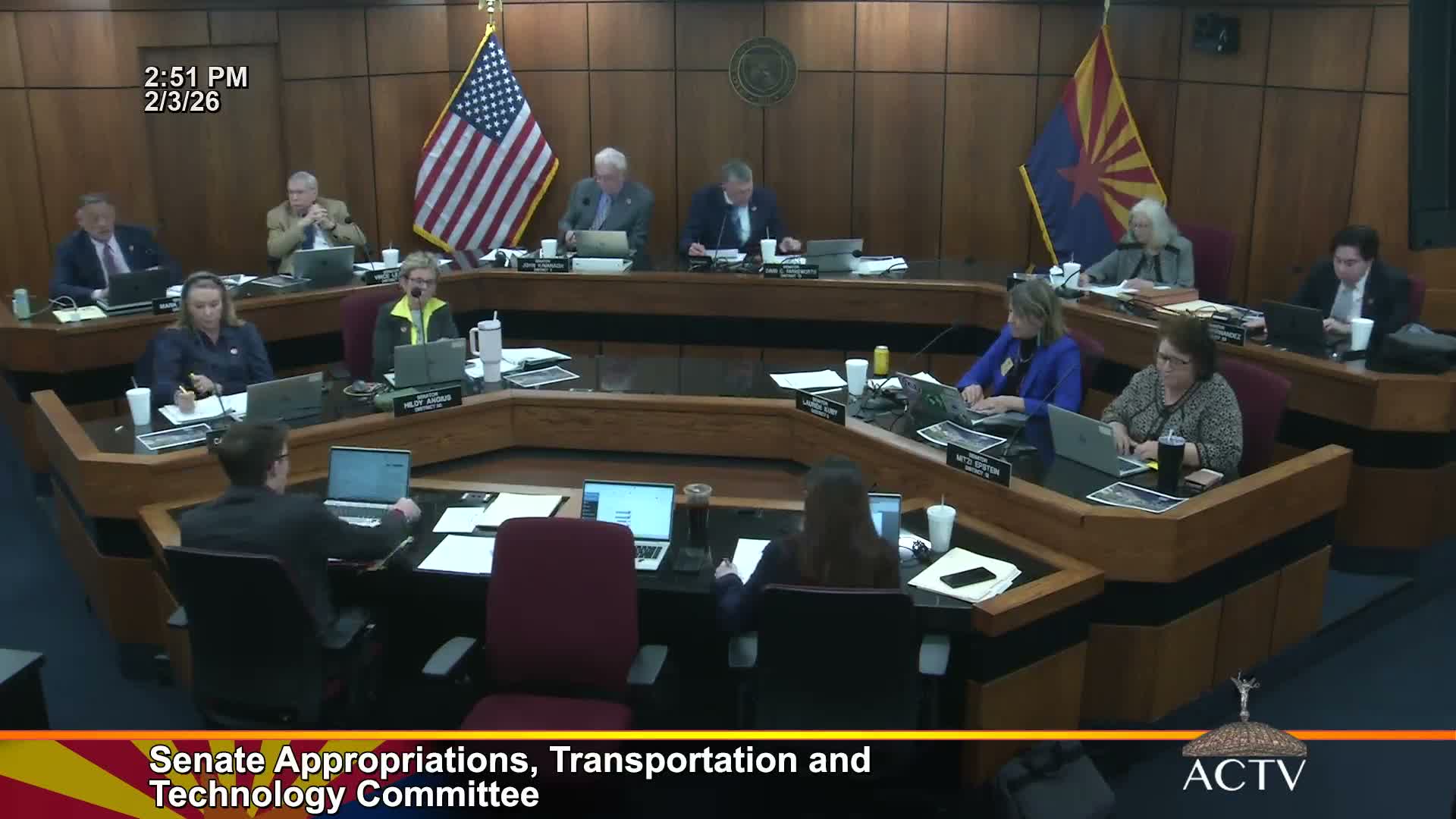
Summary
The committee advanced SB 12-04, a $5.5 million appropriation for design and environmental analysis of the US 60/Loop 303 interchange, and SB 12-07, a $150,000 ADOT study on financing mechanisms. Local officials described persistent multi-mile backups, emergency response delays and growing freight pressure.
The Senate Appropriations committee advanced two items aimed at the heavily congested US 60 / Loop 303 corridor: SB 12-04 (a $5.5 million appropriation for design and environmental work) and SB 12-07 (a $150,000 study on financing mechanisms to better align development and infrastructure funding).
Sponsor testimony (Senator Schamp) described current volume exceeding 60,000 vehicles per day and projections exceeding 160,000 by 2050; he said failing infrastructure is producing more crashes and delayed emergency response. Local speakers — Surprise resident Lisa Everett and City Councilman Nick Haney — described daily gridlock and multi-mile backups; Lloyd Abrams, assistant city manager for Surprise, told the committee the bill would fund coordination between local governments and ADOT to reduce long-term costs.
Why it matters: Schamp said design funding is “the most cost-effective step” to control future costs and improve federal funding eligibility. Witnesses warned that failure to plan will shift larger construction costs to state and local taxpayers and degrade safety and response times. The committee discussion included objections that the work should be paid from the Highway User Revenue Fund (HEERF) rather than the general fund, with senators noting competing budget pressures.
Committee action: SB 12-04 received a due-pass recommendation (8 ayes, 1 no, 1 not voting). SB 12-07 similarly advanced (7 ayes, 1 no, 2 not voting). Sponsors said the $5.5 million is design-only and not construction funding; ADOT would use the work to pursue federal matching and prepare projects for later construction.
Next steps: Both measures proceed toward floor consideration. Committee members requested continued coordination between ADOT, JLBC and local governments on project prioritization and funding sources.