Committee advances package of fuel bills: temporary gas tax suspension, reviews of summer blends and studies of alternatives
Loading...
Summary
Lawmakers advanced a set of bills targeting fuel prices and the 'cleaner burning gasoline' program, including HB 2,400 (temporary fuel-tax suspension with state transfers), HB 24-01 (biennial review of fuel formulations), HB 20-14 (modeling and feasibility study with $100,000 appropriations), HB 26-96 and HB 29-55; committees heard industry, cities, counties and environmental groups and adopted multiple amendments.
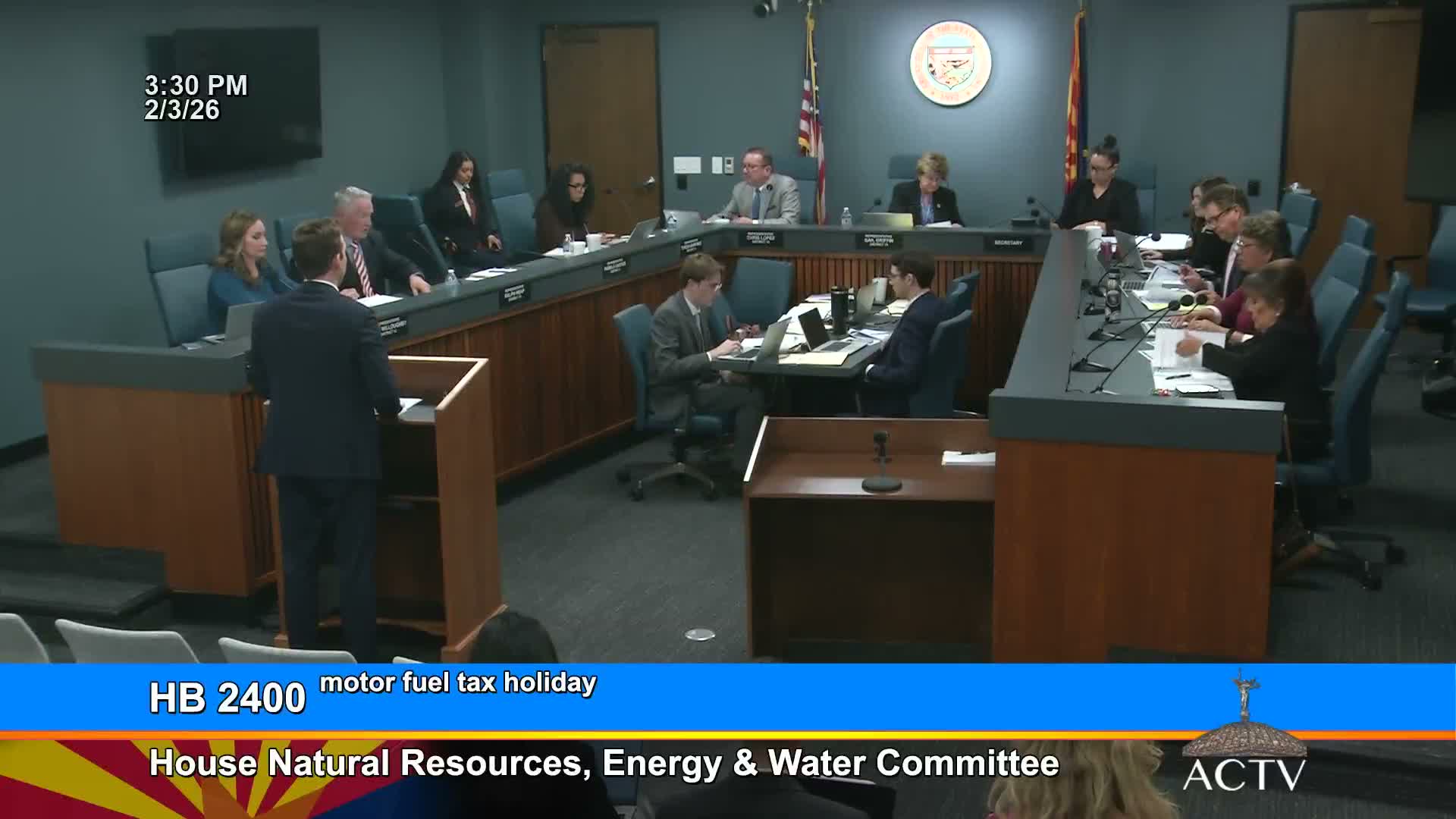
A cluster of bills addressing summer gasoline blends, fuel supply resiliency and short-term affordability measures moved out of the Natural Resources, Energy and Water Committee on Feb. 2 after extensive testimony from cities, counties, industry and environmental groups.
Key measures and committee actions
- HB 2,400 (sponsor Representative Willoughby): Would suspend the motor vehicle fuel tax in Areas A and C each May 1–Sept 30 and prohibit vendors from recovering the suspended tax from consumers; the bill required ADOT to transfer $76,600,000 from the State Highway Fund under the adopted Griffin amendment. The sponsor framed the measure as an affordability step tied to 'boutique' EPA gasoline requirements for Maricopa and Pinal counties. County and municipal officials, the League of Arizona Cities and Towns, and transportation stakeholders warned the committee that suspending the tax would erode the Highway User Revenue Fund (HEERF) and state highway fund; the County Supervisors Association estimated a potential HEERF revenue reduction of about $147.6 million for the period described. The committee adopted the Griffin amendment and returned HB 2,400 as amended with a due-pass recommendation (committee reported 6 ayes, 4 nays).
- HB 24-01 (Representative Goldby): Directs ADEQ to conduct a biennial review of available fuel formulations for Areas A and C and assess anticipated air quality impacts. ADEQ said it is neutral and already performs modeling when a new formulation is proposed; the agency cautioned the study’s value depends on whether alternative formulations are available. The committee returned the bill with a due pass recommendation (vote recorded 6 ayes, 4 nays).
- HB 20-14 (Representative Lisa Fink): Requires ADEQ and the Department of Agriculture’s Weights & Measures division to complete air emissions modeling of certain gasoline formulations and conduct feasibility studies; includes one-time appropriations of $100,000 to each agency in FY27 for modeling and feasibility work. ADEQ and the Department of Agriculture said they are neutral and that timelines and budgets may need modest adjustment given procurement and modeling demands; industry (Western States Petroleum Association) asked for narrower scope and cautioned about SIP and EPA constraints. The committee adopted a Griffin amendment and returned HB 20-14 as amended with a due-pass recommendation (10 ayes, 0 nays).
- HB 26-96 and HB 29-55 and HCM 2008: HB 26-96 asks the Arizona Commerce Authority to prioritize reducing fuel prices through 2029 and report findings; HB 29-55 modifies fuel reformulation rules and conditions enactment on EPA approval; HCM 2008 urges Congress/EPA to eliminate or waive the federal gas tax for EPA-approved specialty blends sold in Maricopa and Pinal County. Each measure was returned with a due-pass recommendation after stakeholder comment.
Stakeholder themes and technical constraints
City and county officials repeatedly warned that the state and local transportation funds are under severe stress and that suspending the fuel tax without durable replacement revenue would worsen road maintenance backlogs. Industry witnesses emphasized that Arizona’s cleaner-burning gasoline (CBG) program is part of the state implementation plan (SIP) to meet ozone standards, and that any changes require EPA review and cannot 'backslide' in emissions. ADEQ and Weights & Measures said they can support modeling work but requested realistic timelines and noted that most reviews are triggered when an industry stakeholder proposes a new formulation.
What comes next: The bills proceed to the House floor. Sponsors and agencies signaled willingness to continue stakeholder engagement and to refine timelines, appropriations and technical language before floor or conference action.