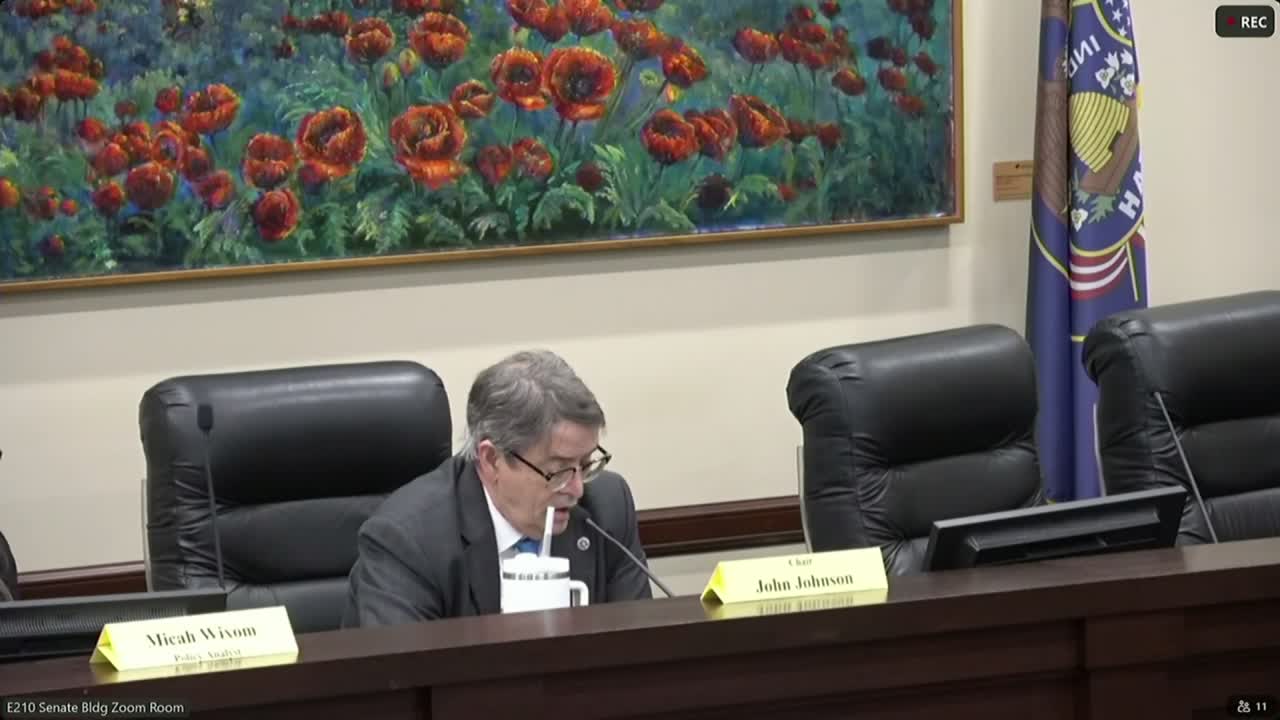
Committee advances SB 85 substitute to expand teacher award eligibility; some members oppose expansion
Loading...
Summary
The committee approved a substitute for SB 85 to allow teachers in tested subjects at nonparticipating LEAs to self‑nominate for Excels awards and adjusted administrative dates; proponents said one‑time funds should reach eligible teachers, while associations urged study of pilot data before expansion.
The committee voted to favorably recommend the first substitute to Senate Bill 85, which modifies the Excels teacher‑bonus program to allow teachers in tested subjects who work in nonparticipating local education agencies (LEAs) to self‑nominate for awards and updates timing deadlines at the State Board of Education's request.
Senator Fillmore and David Forbush of Utah State University’s Center for the School of the Future said the substitute mainly adjusts dates to give the State Board more time to administer the program and expands eligibility so individual teachers in tested subjects at nonparticipating LEAs can be considered. Forbush said the program aims to identify and reward teachers who produce the greatest student learning.
Committee members asked how many LEAs are participating (Forbush said 24 LEAs are participating now, down from about 50 who expressed initial interest) and about the program’s fiscal note; the sponsor said the program was originally funded at about $150 million and later reduced to roughly $112 million, which was prefunded to cover three years of bonuses.
Speakers representing school administrators and boards urged caution. Lexi Cunningham, representing the Utah School Superintendents Association and Utah School Boards Association, said six districts have been committed from the beginning and that the associations do not support expanding the program to individual teachers; she recommended studying pilot data and considering other uses for the money. Jenny Earl, a member of the State Board of Education, raised questions about how teachers would be identified and how individual awards would interact with local board processes.
Senator Fillmore argued the money was set aside as one‑time funding intended for a pilot and should be available to recognize excellent teachers statewide, even in districts that chose not to participate. The committee recorded two members as opposed (Hankins and Reby) but the substitute received a favorable recommendation and will move to the full Senate for further consideration.