Get Full Government Meeting Transcripts, Videos, & Alerts Forever!
Get email alerts on the Data Equity topic
No spam. Unsubscribe anytime.
Austin Equity and Inclusion previews mobility-mapping tool to pinpoint neighborhood disparities
Summary
At the Dec. 12 Mayor's Committee meeting, Austin Equity and Inclusion presented a place-based mobility index and mapping tool that uses public data (Census, ACS) and 18 indicators to identify neighborhood disparities; the office said a fuller product is expected around March and asked commissioners for feedback.
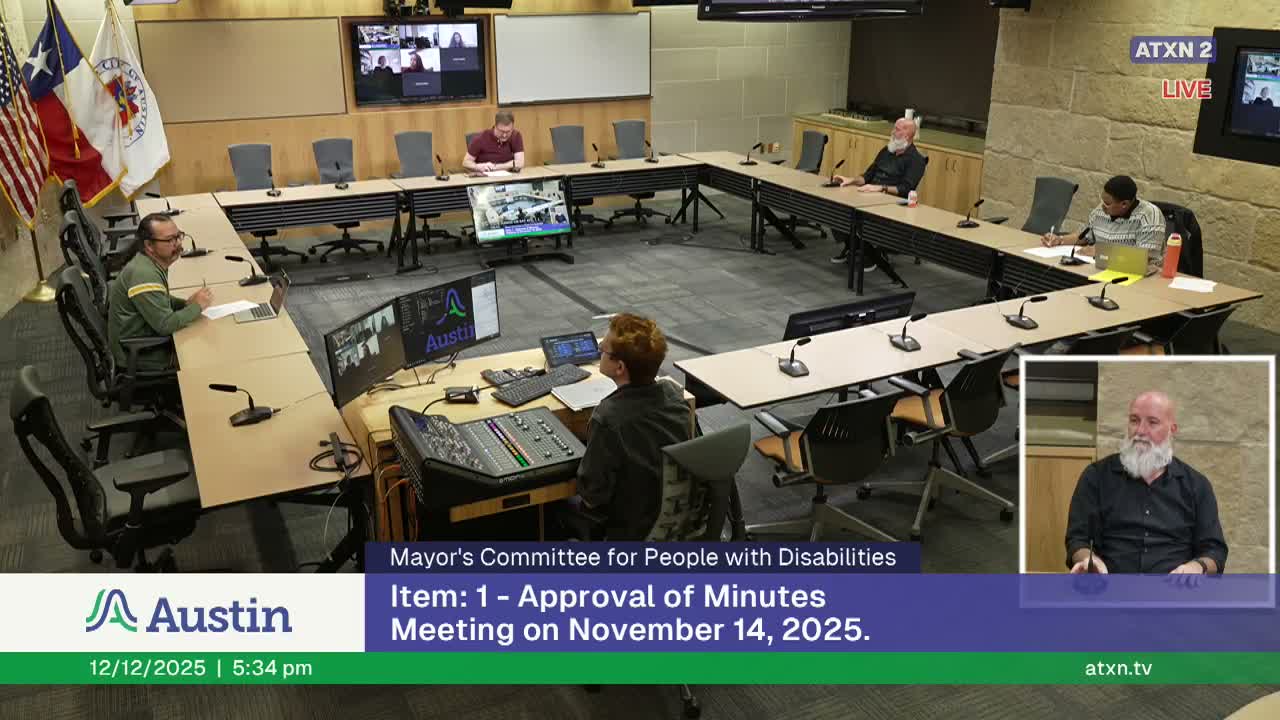
Austin Equity and Inclusion presented a place-based, data-informed mapping tool at the Mayor's Committee for People with Disabilities meeting on Dec. 12, 2025, aimed at identifying disparities in community conditions and guiding cross-departmental decisions.
Shivani Datar, a business process specialist with Austin Equity and Inclusion, said the office frames the effort as a mobility index that will pair a public-facing map with a report and measurable indicators. "Like how 12% of Austinites are living in poverty, and of the disabled community, 20.2% are living in poverty," Datar said, using those figures to illustrate the disparities the tool seeks to surface.
Datar said the tool will start with a set of preliminary, people-focused indicators (examples: median household income, access to health insurance, limited English proficiency) that are subject to revision based on stakeholder input. She said the office plans for a final set of 18 indicators, equally weighted, to allow departments and community members to track change and accountability.
Gary Aaron, senior business process consultant with Austin Equity and Inclusion, named EveryTexan as the vendor providing data science support. Aaron described the vendor role as performing data aggregation and statistical steps (including principal component analysis) to reduce overlap among indicators so each contributes uniquely to the index.
On data sources and privacy, Datar said the tool will draw from public sources such as the U.S. Census and the American Community Survey and will not collect individual-level data: "We're not collecting any personal or individual level data." Commissioners urged the team to consider supplemental, informal datasets and stakeholder organizations that may capture populations reluctant to identify disability status in formal surveys.
Commissioner Kristen Fasalo recommended that the tool explicitly consider people with intellectual and other specific disability types; Datar and Aaron said the current indicators include "persons with disability" and "persons 65 plus with an ambulatory disability" and that the office is open to incorporating additional disaggregated measures through continued engagement.
Presenters asked committee members three focused questions about community priorities, drivers of opportunity, and changes that would most improve mobility; Chair Kelly invited commissioners to provide immediate input or send ideas later via staff. Aaron and Datar said the office expects to return with a more complete product around March for further engagement and review.
Next steps: committee members were asked to submit feedback by email to staff and to expect a follow-up presentation when the product is more developed.