Get AI Briefings, Transcripts & Alerts on Local & National Government Meetings — Forever.
Virginia House Finance subcommittee hears multiple tax, housing and family-support proposals; several bills tabled, three reported
Loading...
Summary
The subcommittee reviewed more than a dozen bills including proposals on broadband grant tax treatment, volunteer firefighter credits, a child tax credit, and amendments to the land‑preservation and solar incentive programs; many were tabled after fiscal concerns, while HB 958, HB 1180 and HB 1454 were reported to the next stages.
A House Finance Subcommittee No. 1 meeting on Feb. 5, 2026, heard testimony on a string of tax and policy bills that the panel largely delayed for further study, while moving a handful forward.
The panel considered bills on broadband grant tax treatment, tax credits for volunteer fire and rescue personnel, a child tax credit, housing tax changes intended to unlock inventory, solar incentives and changes to how multistate businesses account for net operating losses. Committee members repeatedly cited large and uncertain fiscal impacts as the reason many measures were “gently laid on the table.”
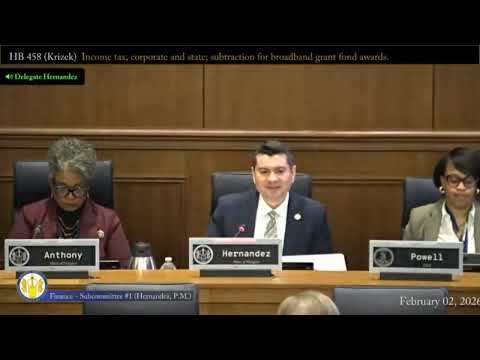
Broadband providers and their trade association told the subcommittee that taking grant awards into taxable income creates an up-front tax liability that hits small providers hard. "We're giving money and then we're taxing it," Rich Shulman of the Virginia Broadband Industry Association said, urging a technical change that would exclude governmental broadband grants from taxable income. Committee members questioned the difficulty of estimating revenue effects and voted to lay that bill on the table.
Bills targeting housing and homeownership drew robust discussion. Delegate Sewell said his bill would "unlock opportunities" by providing a subtraction for long-term capital gains on property sales; Realtors and business groups said the change could free inventory for first-time buyers, while the committee flagged a potential annual fiscal impact of about $300 million and tabled the measure.
On family supports, Delegate Cathy Tran described HB 1004 as targeted relief that would provide a one-time refundable child tax credit worth $300 per child under 13 and estimated it would reach roughly 781,000 Virginia children. Supporters including the Commonwealth Institute and the Virginia Education Association said refundable credits reduce child poverty; the committee nevertheless opted to lay the bill on the table pending broader fiscal trade-offs.
Energy and environment proposals also moved through debate. A pilot residential solar income-tax credit (15% up to $1,000) was presented as a way to replace federal incentives that expire; conservation groups backed the idea but the committee cited potential program take-up and cost and voted to table it. A proposal to restore the land preservation tax credit cap from $75 million to $100 million won backing from land trusts but drew caution about competing uses for limited revenue and was tabled.
Three items were advanced. The subcommittee voted to report HB 958, which revises how multistate net operating losses are accounted for, with no fiscal referral required in the committee record; HB 1180, establishing alignment with a funded statewide electronic filing system to provide free e-file access for taxpayers, was reported unanimously; and HB 1454, exempting the Segal AmeriCorps Education Award from Virginia income tax beginning Jan. 1, 2026, was reported and referred to appropriations after testimony from AmeriCorps alumni and volunteer-service leaders.
Procedural actions dominated roll calls. Many patrons thanked the committee for consideration and several witnesses described how the bills would affect specific constituencies from small broadband providers and rural hospitals to volunteer first responders, AmeriCorps alumni and first‑time homebuyers.
What happens next: Bills reported by the subcommittee proceed to the next legislative steps (including referrals to appropriations when noted); items laid on the table can be called up again by a subsequent motion. Committee members said fiscal modeling and targeting details will guide whether any of the tabled proposals are revived or incorporated into the budget.
The subcommittee adjourned after completing the docket and confirmed a quorum for the session.