
Committee reviews H.775 rural housing finance bill, asks counsel to clarify treasurer's credit authority
Get AI-powered insights, summaries, and transcripts
Sign Up Free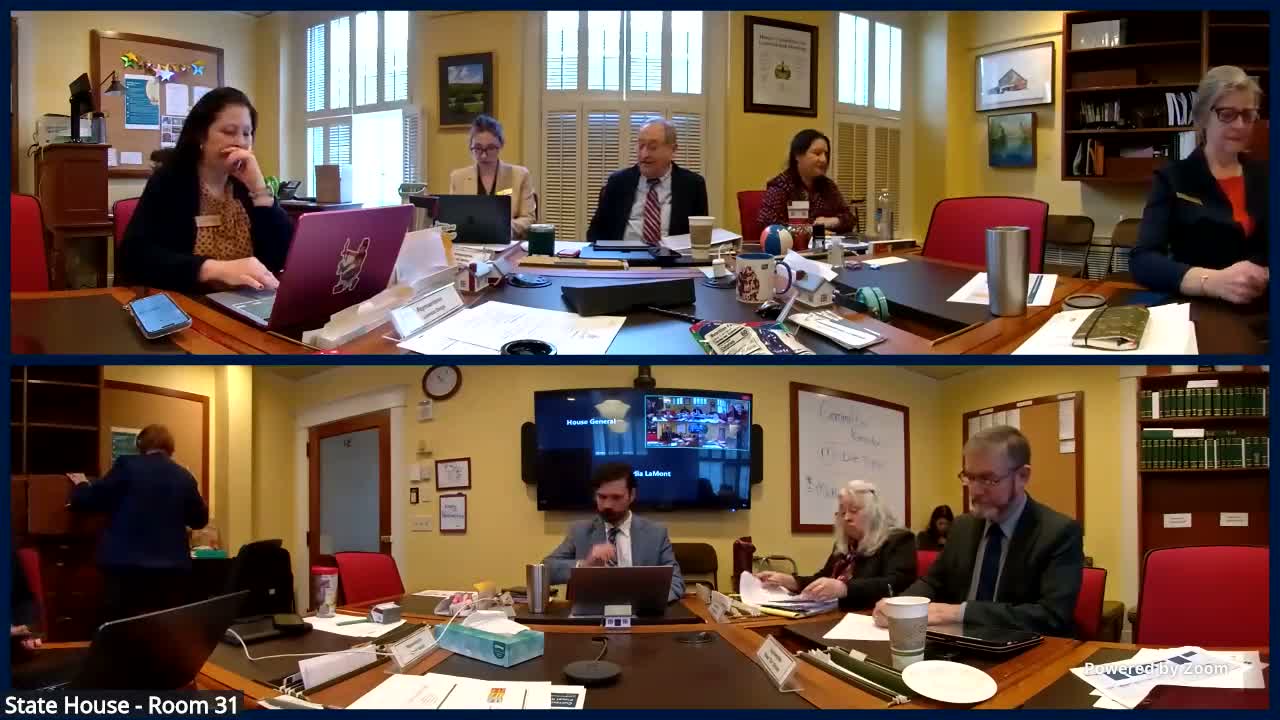
Summary
At the Feb. 4 General & Housing Committee markup, members reviewed H.775—66a rural housing pilot—66special-assessment revenue bonds—66and an increase to the treasurer's credit authority from 10% to 12.5%. Counsel was asked to draft clearer statutory language and to consult the state treasurer about whether a 1% allocation is part of or additional to the 12.5%.
At a Feb. 4 meeting of the General & Housing Committee, members continued markup of H.775, a rural housing finance bill that would authorize a Department of Housing and Community Development pilot to support up to 300 housing units, allow municipalities to issue revenue bonds backed by special assessments on consenting properties, and expand the state treasurer's credit authority.
Cameron Wood of the Office of Legislative Council summarized the bill's main pieces: a DHCD-run rural housing finance pilot in section 1; a section authorizing municipalities to issue revenue bonds backed by special assessments; an increase in the treasurer's credit facility from 10% to 12.5% of the state's average cash balance; an off-site construction accelerator pilot for bulk purchase of modular units; and changes to the VHIP program to allow upfront loans or grants to developers. "The proposal here would be to expand that to 12.5%," Wood said when describing the change to the treasurer's authority.
Members flagged several drafting and policy questions for counsel and for the treasurer's office. A recurring point concerned a 1% credit facility provision: counsel and members questioned whether the bill language intends that the 1% is a subset of the 12.5% (one percent of the total) or an additional, additive 1% that would increase the total. Counsel said the current statutory wording reads as part of the total and recommended rewording to make the drafters' intent explicit.
The bill would also let the treasurer retain interest earned on loans from the credit facility and deposit that interest into a new "Vermont housing special funds" to support bulk purchasing of off-site constructed housing. Wood warned members that while the policy is feasible, "the interest is going to be a little controversial" with other committees because interest currently flows to the general fund.
Committee members discussed practical effects and scale. Participants offered back-of-envelope estimates of state cash balances during the hearing and cautioned those numbers were illustrative, not definitive; members asked the treasurer's office for precise calculations. The committee also debated inclusionary zoning implications for very small rural projects: some members noted that tax-credit financing and other affordability tools are often unavailable on projects of only a few units, and that imposing inclusionary requirements could change project economics.
On off-site construction, witnesses and members flagged potential benefits to a statewide code and factory inspection regimes for modular units. Counsel and members agreed to add coordination language so the treasurer's office and the agencies administering housing programs would be consulted on the credit facility's design rather than restructuring the treasurer's investment committee.
No formal motions or votes were taken. The committee asked counsel to draft clearer statutory language on (1) the relationship of the 1% provision to the proposed 12.5% credit facility, (2) the treasurer's authority to use retained interest to offset inclusionary costs in the pilot, and (3) modest wording tweaks (for example, replacing "by law" with "ordinance" and allowing one or more municipalities to participate in the pilot). Chair and counsel also said they will follow up with the treasurer's office to confirm the treasurer's view of existing legal authority.
The committee will return to the bill after counsel circulates draft language and after the treasurer's office provides the requested clarifications. The afternoon session will shift to landlord-tenant bills, which counsel said will be dense and include several items.