
Committee advances HB 378 to strengthen controls, signage and inspections at sand-and-gravel pits
Get AI-powered insights, summaries, and transcripts
Subscribe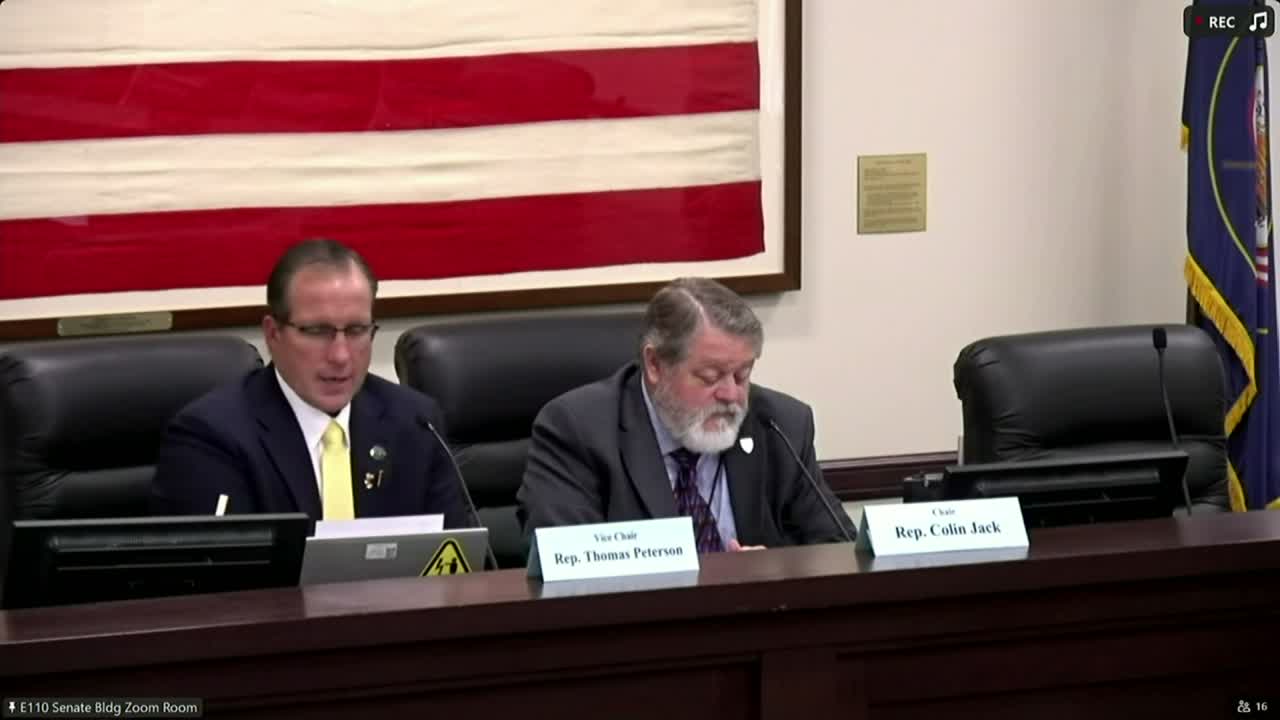
Summary
The House Public Utilities and Energy Committee advanced HB 378, which targets fugitive dust from sand-and-gravel operations by allowing a capped fee increase to fund additional inspectors, requiring on-site signage for community contacts, and continuing a stakeholder work group; the committee passed the second substitute with a favorable recommendation (one recorded nay).
Representative Grisius introduced HB 378, titled the "fugitive dust mitigation amendments," as a targeted package to address dust impacts where multiple sand-and-gravel pits surround communities such as Genola. She told the committee the measure was developed by a multi-stakeholder working group with industry, local officials and state regulators.
"This only applies to sand and gravel," the sponsor said, and described three central elements: tightened definitions, a capped fee increase that would allow the division to hire two new inspectors, and a requirement that pits post signage identifying an on-site contact and how to reach the Department of Environmental Quality (DEQ).
Tim Davis, executive director of the Department of Environmental Quality, said the bill's value is the convening of parties after years of growth near pits. "We had not had all the parties at the table for over 10 years," he said, and the proposal is intended as a first step to balance industry and neighbor concerns.
Division of Air Quality director Bryce Bird explained the regulatory terms and scope. "If it comes from area activities, that's our term of art that we use nationwide, and that becomes fugitive dust," he said, and added that the division collects roughly 1,500 fugitive-dust control plans a year, with over 1,000 from aggregate operations. Bird also noted the control-plan requirement applies beyond quarries to land clearing and subdivision work.
Committee members raised two recurring concerns. Representative Albrecht asked about the number of pits near Genola (the sponsor said "7 or 8") and warned that new costs on producers can push material and construction costs higher for taxpayers. Representative Chu described a case where on-site monitors logged excess dust on a weekend when the pit was not active, asking how monitoring or complaint-based enforcement would treat such edge cases; the sponsor and DEQ responded that the bill does not change numeric limits but requires signage so neighbors can contact operators directly and file complaints when necessary.
Multiple industry and agricultural stakeholders spoke in support during public comment. Dave Callas of the Critical Infrastructure Material Coalition and Nate McDonald of Clyde Companies said participants in the working group helped craft the bill and support the signage and inspection funding. Terry Camp of the Utah Farm Bureau described orchard damage from drifting dust and urged measures that protect crops while still supplying construction materials.
On committee action, Representative Albrecht moved to adopt the second substitute and the committee approved it. Later, the committee voted to pass out the second substitute with a favorable recommendation; Representative Scott Chew was recorded as a no on that recommendation. The bill will proceed from the committee for further consideration.
The committee's next procedural step was to pass the substitute and send the bill forward; members thanked the sponsor and staff for convening stakeholders.