
Snoqualmie committee hears Verra Mobility presentation after three‑day speed study; council asks staff for privacy and capacity details
Get AI-powered insights, summaries, and transcripts
Sign Up Free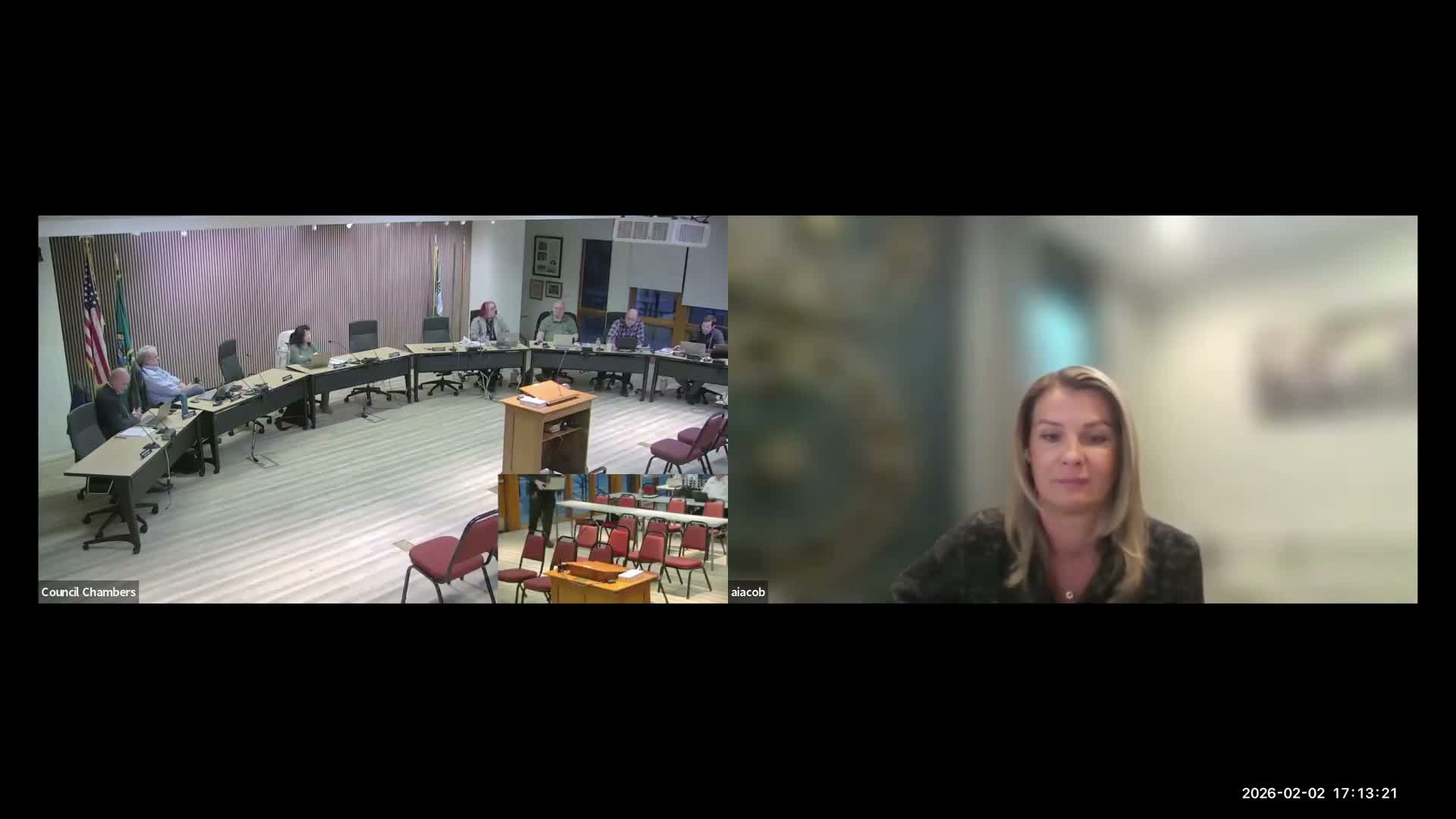
Summary
The Public Safety Committee received a Verra Mobility presentation on automated school‑zone speed enforcement based on a three‑day speed survey. The vendor proposed a fixed camera system and back‑office processing with no upfront cost; council members pressed staff on data storage, subpoena risk, officer workload and alternatives such as traffic‑calming measures.
The Snoqualmie Public Safety Committee on Feb. 2 heard a presentation from Verra Mobility and city staff about automated school‑zone speed enforcement following a three‑day speed survey. Verra Mobility representative Alexandra Jacob said the survey captured vehicle counts and extreme speeds—one reading reached 93 mph and another 86 mph on the parkway near Timber Ridge Elementary—and that the vendor’s modeling assumes roughly 5% of observed speeding would become potential violations after public outreach and a 30‑day warning period; about 10% of citations were modeled as likely to be contested in court.
Jacob described a fixed pole‑mounted system that captures three still images and a 12‑second video for each potential violation, a 3‑D radar that can track multiple vehicles and a secure back‑office platform used for evidence review, reporting and integration with Issaquah Court. She said Verra Mobility would store the captured data on its servers but that the city would maintain ownership and that data‑retention rules would be set during implementation. Jacob also said Verra Mobility provides end‑to‑end services including installation, maintenance, case preprocessing and court support.
Council members pressed for operational and legal details. Interim Chief provided 2025 enforcement statistics for local corridors, including 238 infractions, 38 collisions and 723 traffic stops on Snoqualmie Parkway; other corridors showed dozens of infractions and multiple collisions in 2025. Committee members raised privacy and subpoena concerns about vendor‑hosted evidence, and Council member Brian Holloway said he did not want to “put cameras on streets” in the current environment and warned against treating enforcement as a revenue stream. Chair Wotton and staff said rollout options are available—an initial warning/education month, limits on the number of citations issued and business rules that could reduce officer review workload—and staff committed to returning with more detailed numbers, alternative traffic‑calming measures and draft ordinance language.
Committee members also clarified that the system is not fully automated: state law requires a law‑enforcement officer to review evidence and confirm a violation before a citation is issued; contested cases would still require officer testimony and Verra Mobility said it would provide expert witnesses to support court appearances. The committee ended the discussion by asking staff to present cost, staffing and privacy controls, and to include non‑camera traffic‑calming options at the next meeting.
The committee did not make a procurement decision; staff will return with additional analysis and potential ordinance text at a subsequent meeting.