Get Full Government Meeting Transcripts, Videos, & Alerts Forever!
Get email alerts on the Land Use Pud topic
No spam. Unsubscribe anytime.
Idaho Falls council denies Willow Place Townhomes PUD after extended public hearing
Summary
After more than two hours of presentations and public testimony, the Idaho Falls City Council voted to deny the Willow Place Townhomes planned unit development (PUD), citing concerns about private streets, density, and neighborhood compatibility. Council directed staff to draft a written reason statement for the denial.
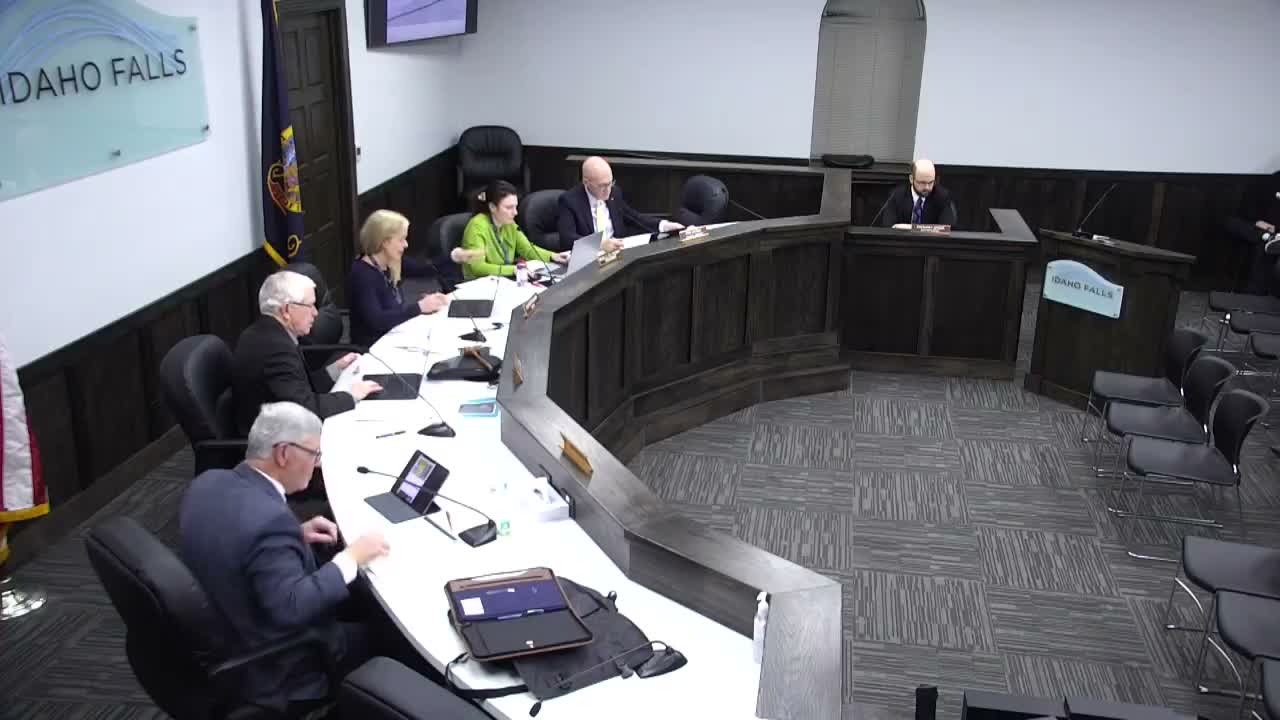
The Idaho Falls City Council voted on Jan. 22 to deny the Willow Place Townhomes planned unit development as presented after a lengthy public hearing and substantial public comment.
The project’s consultant presented plans for 14 single-family attached units on about 1.815 acres, requesting a PUD to allow a private street and a 20-foot front setback in exchange for public amenities and an increased density (8 units per acre under PUD rules). City staff explained the PUD standard that the minimum PUD size is 2 acres unless the council finds the land is redeveloping, provides a public benefit or amenity, or otherwise qualifies under the municipal code. The applicant argued the site qualifies as infill redevelopment and offered amenity access and infrastructure improvements.
Neighbors and numerous residents testified in opposition, raising concerns about traffic and parking on Bellen Road and nearby streets, stormwater/drainage at the site, emergency vehicle access on the proposed private hammerhead turnaround, impacts on school capacity, and the project’s compatibility with adjacent single-family homes. One resident noted neighbors had used the property for years for backyard access and questioned whether the lot should be regarded as permanently vacant.
Council discussion emphasized the narrowness of the private street, the number and scale of variances requested (including the reduced front setback and maximum density), and uncertainty that the amenities would function as an actual public benefit rather than private facilities. Several council members said the parcel did not clearly meet the PUD exceptions for being redevelopment or providing a public benefit; others cited litigation risk if arbitrary standards were applied differently.
Councilor [Francis] moved to deny the PUD as presented; the motion carried on a roll-call vote. The council then directed staff and the legal department to draft a written “statement of relevant criteria and standards” documenting the factual and legal bases for the denial and to return with the draft for review at a future work session.
What happens next: the developer may revise and resubmit a proposal that provides a public street and/or reduces density, pursue the by-right development options the R-1 zone allows, or seek other discretionary approvals. The council’s written reason statement will be the official record for the denial and will outline the findings the council relied on for its decision.