Get Full Government Meeting Transcripts, Videos, & Alerts Forever!
Get email alerts on the Apprenticeship Ratio Relief topic
No spam. Unsubscribe anytime.
Fire Board adopts unified policy for hiring‑ratio relief under Public Act 2547
Summary
The Fire Board approved a unified policy for granting hiring‑ratio relief under Public Act 2547 that requires sponsors to demonstrate 'good cause' and supply a licensee/apprentice roster; the board also endorsed a suggested violation/penalty table and agreed to monitoring and interagency notifications. Vote tallies were not specified in the transcript.
The Fire Board voted to adopt a unified policy for granting hiring‑ratio relief under Public Act 2547, approving a package that sets application requirements, supervision expectations and a suggested violation and penalty table.
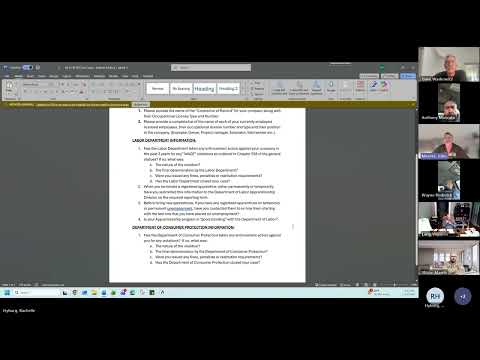
John, who presented the policy to the board, said the application will require sponsors to ‘‘substantiate good cause’’ and upload a spreadsheet listing licensees and current apprentices so the board can confirm daily direct supervision will be available in the field. He told members the board will review requests that would increase a sponsor’s total apprentices to more than eight; applications for fewer than eight apprentices are handled at the departmental level unless tied to disciplinary action.
The policy package includes: a requirement that sponsors name a licensee who will be available for daily direct supervision (not an office‑only employee); a requirement that granted apprentices be placed into work within 45 days; and a form asking sponsors to document layoffs and any notification to the Department of Labor apprenticeship division when an apprentice is terminated. The presentation also included a recommended violation/penalty table modeled on an existing memorandum of understanding, in which first offenses (for example, failure to display a license) can lead to the deduction of an apprentice position and repeated or more serious violations would carry larger deductions.
Board members raised enforcement and oversight concerns. One member warned that the program could operate on an ‘‘honor system’’ and asked what would prevent employers from obtaining relief and then losing journeymen or laying off staff, leaving apprentices undersupervised. John and other members said employers attest to current conditions at application, that the Department of Labor retains enforcement responsibilities, and that the board can require a company to return for review and rescind granted relief if violations are discovered. As John put it during the meeting, "this ratio relief was never meant to circumvent the 1 to 1 job site ratio."
The board also discussed interagency communications, noting the Department of Consumer Protection (DCP) and Department of Labor (DOL) will need notification pathways when complaints or changes in contractor staffing affect granted relief. The chairs of the four affected boards agreed to pursue consistent questions and a consistent violation table so sponsors are treated uniformly across the covered occupations.
After discussion, a board member moved to approve the policies as presented and another seconded the motion. The chair called for the vote and members signified assent by voice; the motion passed unanimously. The transcript does not record individual vote tallies. The board set a follow‑up practice of reconvening the four chairs roughly six to eight months after adoption to review whether policy changes are necessary. The next meeting was noted as February 26 (Zoom).