Get Full Government Meeting Transcripts, Videos, & Alerts Forever!
Get email alerts on the Governor Speech Policy Overview topic
No spam. Unsubscribe anytime.
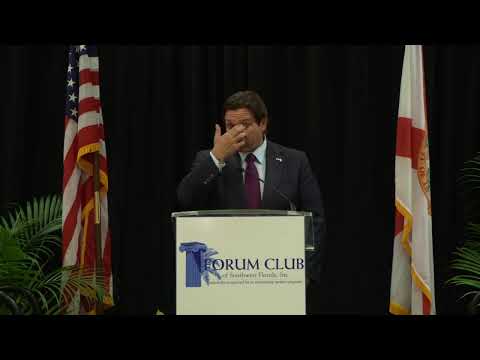
Speaker Identifying as Governor Outlines Education, Crime, Everglades and AI Priorities in Southwest Florida Remarks
Summary
An unidentified speaker who identified himself as governor delivered a wide-ranging speech in Southwest Florida highlighting universal school choice, higher-education governance changes, law‑and‑order measures, Everglades restoration investments and a proposed "bill of rights" for artificial intelligence.
An unidentified speaker, who identified himself as governor, used remarks in Southwest Florida to outline accomplishments and upcoming priorities across education, public safety, the environment and technology.
The speaker said the state has implemented "universal school choice" so "every parent can choose the school of his or her choice," and cited enactment of a "parents' bill of rights" intended to increase parental authority over education. On higher education, he said the public university system ranks No. 1 and described governance changes including five‑year reviews for tenured faculty and the use of boards of trustees to appoint outside scholars bypassing faculty committees: "They don't go through the faculty. The faculty can't block them. They go to the board of trustees, and they get appointed." (Speaker quote.)
On public safety, the speaker credited aggressive prosecution and removals of certain prosecutors with contributing to a "50 year low in the crime rate" in the state and said his administration has removed "Soros-backed district attorneys" from office. He recounted calling a special legislative session to require cooperation by state and local law enforcement with federal interior immigration enforcement and said coordinated action led to "almost 20,000 illegal aliens" apprehended and removed in the past nine months.
The speaker described fiscal policies including no state income tax, repeated tax cuts, elimination of the business rent tax, permanent tax holidays for some items, and an accelerated debt‑repayment program he said retired more than 50% of the state's accumulated debt since he took office. He cited property‑tax revenue rising from $32,000,000,000 to $60,000,000,000 over his tenure and said that, adjusted for population and inflation, the earlier figure would be about $44,000,000,000.
On the environment, he highlighted large investments in Everglades restoration and water quality, noting a reservoir west of Lake Okeechobee intended to reduce discharges into the Caloosahatchee; he said some federal project components were delegated to the state and are running about five years ahead of prior schedules. He also mentioned invasive‑species efforts, saying freezes may reduce iguana populations and discussing hunting programs to remove pythons.
The speaker proposed a "bill of rights for artificial intelligence," arguing states should retain consumer‑protection authority and that technologies should reinforce, not supplant, human values. He closed with general leadership advice and thanked the audience.
The speaker made a mix of factual claims, policy statements and program descriptions; the remarks contained several numeric claims and administrative assertions that were presented without onstage supporting documents. He concluded his remarks with "Thank you."