
Douglas County reviews decade‑old food‑systems plan, flags data gaps and city–county coordination needs
Get AI-powered insights, summaries, and transcripts
Subscribe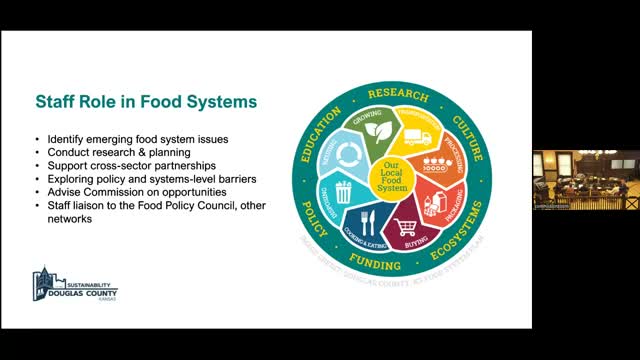
Summary
Douglas County staff presented a review of local food‑systems initiatives and recommended a 10‑year reflection on the 2017 food‑system plan to address outdated data, align conservation and open‑space goals, and strengthen county–city coordination for funding and policy implementation.
Douglas County officials used a work session to review local food‑systems initiatives and discuss whether the county’s 2017 food‑system plan needs updating. Kim Krenner Ritchie, the county’s sustainability manager, framed the briefing by saying the Sustainability Office ‘‘typically falls within 3 broad collaborative focus areas of climate adaptation, food systems, and open space conservation’’ and that the session was intended for exploratory alignment and commissioner feedback.
The presentation highlighted several initiatives led or convened by the Douglas County Food Policy Council, including research on farmers markets funded through a USDA grant and entrepreneurship programs aimed at supporting food‑business startups. Connie Federle Fitzpatrick, the county’s food‑system specialist, described a mobile‑vending policy review and outreach work: in one example the City of Florence moved from a three‑hour vending limit to longer vending windows after council recommendations, and staff developed a one‑on‑one guide in English and Spanish to help vendors establish themselves. ‘‘It would be most successful through a food truck, and 3 hours is not enough,’’ Fitzpatrick said.
Commissioners pressed staff on the currency of the county’s food‑system dashboard and data. Krenner Ritchie and council members said much of the dashboard relies on external sources such as the Census and the agricultural census, which leaves some series last updated around 2020. ‘‘A lot of the data that is on the dashboard is pulled from external sources,’’ Krenner Ritchie said, noting that a new, localized food‑system assessment would require convenings and resources.
Elected officials also sought clarity on how the food‑systems plan intersects with other county plans and policies. Staff reported the council has provided letters of support for conservation work, participated on the open‑space plan advisory committee, and was consulted early in the development of solar regulations. Commissioners discussed whether the county should more deliberately integrate the food‑systems plan with the comprehensive plan (2040) and whether council membership or formal representation from other municipalities should be revisited after the 2022 split of shared sustainability offices.
Funding mechanisms and intergovernmental roles emerged as a recurring theme. Commissioners asked whether policy language that references using Lawrence’s transient guest tax and Douglas County natural and cultural heritage conservation (HCC) grants to support farms or agritourism has been used; staff said HCC grants have supported agriculture‑related projects but that use of the transient guest tax would be a City of Lawrence budget decision.
Staff outlined near‑term and programmatic next steps: continuing the Indigenous Food System Study and Action Plan (with a final report expected later this year), convening partners to assess whether an updated localized assessment or dashboard refresh is warranted, and returning to the commission with any implementation recommendations that require formal action or budget decisions. The work session was informational and recessed into the county’s scheduled business meeting.