Get Full Government Meeting Transcripts, Videos, & Alerts Forever!
Get email alerts on the Displacement Mapping topic
No spam. Unsubscribe anytime.
Community group unveils Austin StoryMap documenting displacement and calls to reopen community funding
Summary
Land Justice Community School presented a StoryMap tracing Austin’s history of segregation and displacement, highlighted local case studies (Rosewood Court, Goodwin Apartments, Acacia Cliffs), and urged the city to reopen Community Initiated Solutions (CIS) funding and add capital grants.
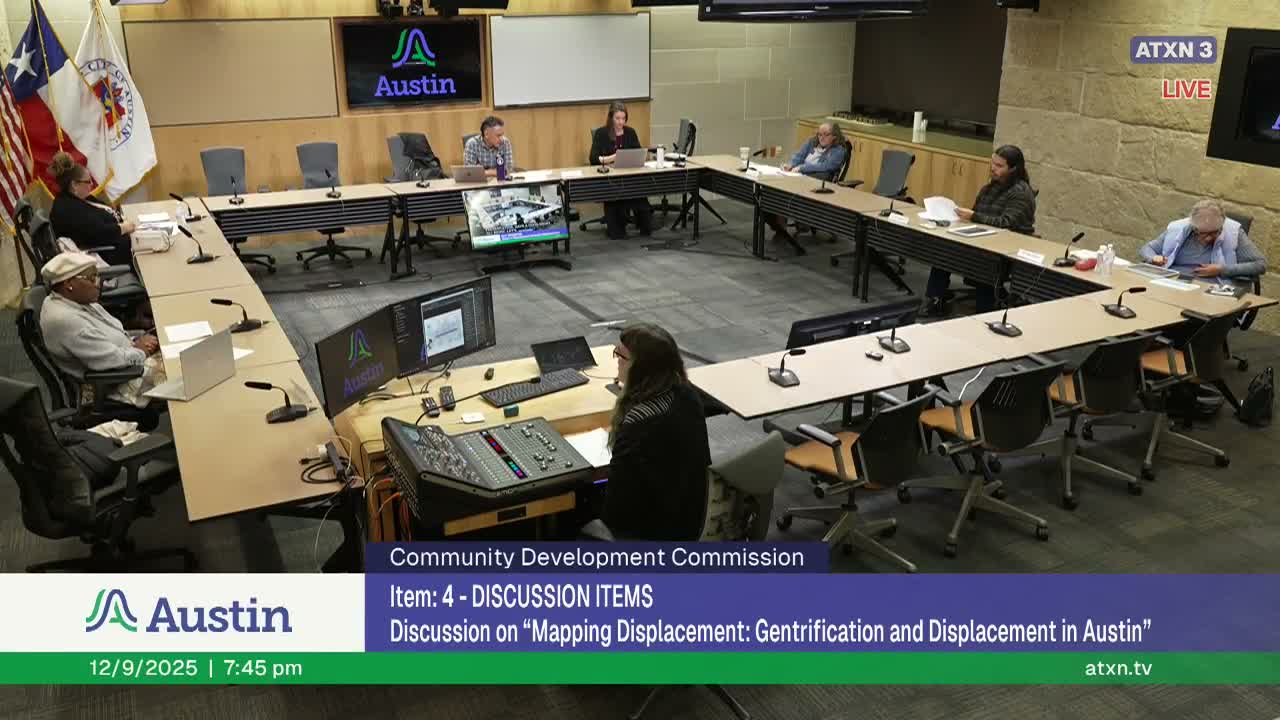
Presenters from the Land Justice Community School — including Genesis Pedraza, Marie Gutierrez and Alexia Lake Clerk — introduced a StoryMap to the Community Development Commission on Dec. 9 that compiles community histories and case studies documenting gentrification, displacement and environmental injustice in Austin.
Genesis Pedraza framed the StoryMap with historical context, recounting early settlement, segregationist municipal planning and federal redlining that concentrated Black and Mexican American residents in East Austin. Presenters emphasized that gentrification is “profit‑driven” and promoted by private development and government policy, and they linked redevelopment to environmental harms such as pollution and creek erosion.
The StoryMap documents more than 20 local stories. Presenters cited Rosewood Court, where private redevelopment and demolition reduced affordable options; the Goodwin Apartments, where redevelopment left fewer than 10% of units affordable and reduced school enrollment at the nearby elementary school; and Acacia Cliffs, which presenters said converted units that were 30–50% area median family income (MFI) levels into market‑rate and luxury units.
Presenters asked the commission to use the StoryMap as a resource, to add more East Austin stories and to press the city to reopen the Community Initiated Solutions (CIS) solicitation and create capital‑grant opportunities. They said the StoryMap will include a policy platform in 2026 and that it links housing justice and environmental justice concerns.
Commissioners praised the work and asked about the equity overlay and next steps; presenters said they are awaiting consultant reports and hope to use those findings to support grassroots advocacy. The commission expressed interest in further collaboration and in receiving updates as the StoryMap and policy platform develop.