Get Full Government Meeting Transcripts, Videos, & Alerts Forever!
Get email alerts on the Home Repair Programs topic
No spam. Unsubscribe anytime.
Austin Housing outlines home‑repair demand, HUD delays and barriers to scaling programs
Summary
Nefertiti Jackman told the CDC that FY25 home‑repair programs served 361 households citywide, logged roughly 1,300 inquiries, and face long startup delays tied to HUD environmental reviews, contractor shortages and outdated data systems.
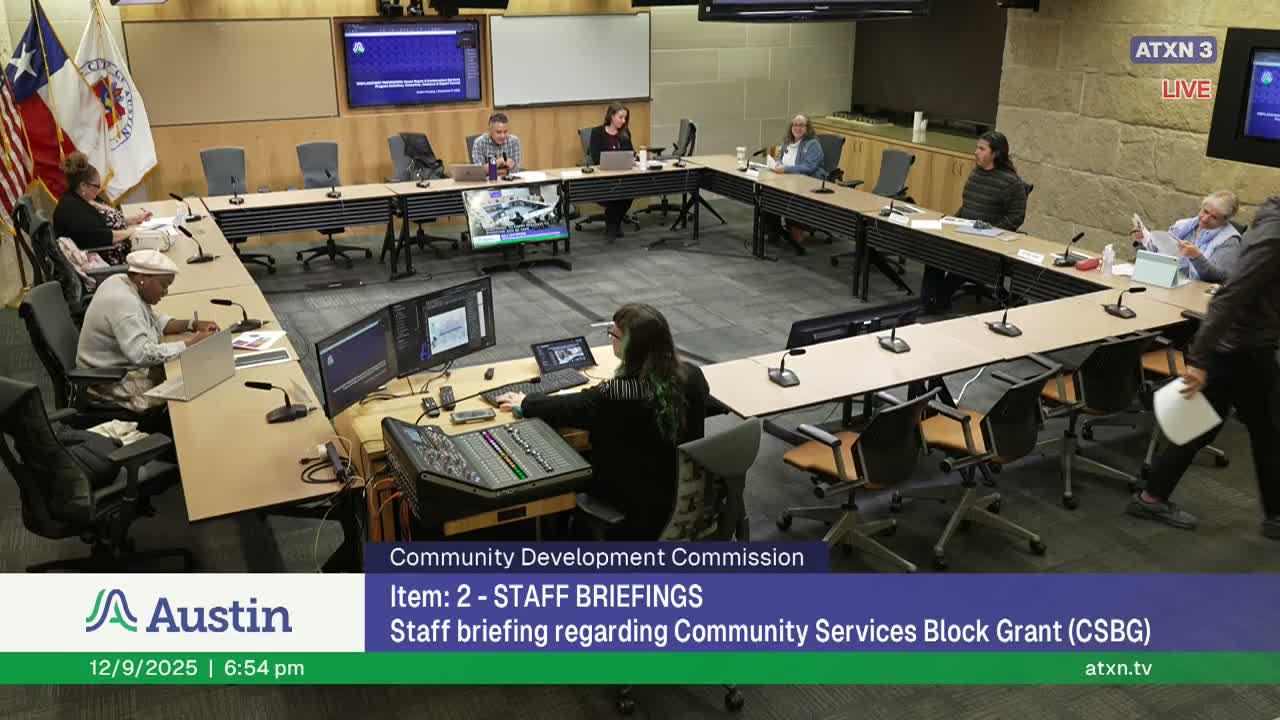
Nefertiti Jackman, Community Displacement Prevention Officer in the Austin Housing Department, told the Community Development Commission on Dec. 9 that home‑repair programs served 361 households in FY25 while the department recorded roughly 1,300 annual inquiries for repair help. She said the department served about 26% of those who submitted an inquiry, noting many applicants do not complete full applications or are ineligible for reasons such as delinquent taxes.
Jackman listed multiple local and federal funding sources for home repair, including Community Development Block Grant (CDBG) funds, Housing Trust Fund dollars, Austin Water contributions and GO Bond proceeds. She said local funds are being used while HUD grants and contracts are pending, but that HUD’s required environmental reviews — a 55‑day process that cannot start until HUD contracts are executed — have created long delays in program starts.
Jackman described program design and access issues: grant programs are no‑cost to homeowners and loans (including 0% interest loan products) are available for larger repairs, with loan ceilings used to address more extensive needs. She said the department has been working to expand its contractor pool — currently about six contractors serve many of the nonprofit partners — and plans outreach to recruit more vendors to serve residents.
Commissioners raised timelines and emergency needs. Jackman said the department is exploring restoring an emergency repair program for urgent cases (for example, recent disability or post‑surgical needs), acknowledging that, under existing processes, some repairs can take a year or more to start because of federal contracting and review timelines.
Jackman also described recent changes to program funding allocation: a Project Connect solicitation for $5 million was canceled; existing community‑initiated solutions programs continue while staff evaluate program impact and consultant recommendations to inform future solicitations.
Commissioners asked for follow‑up information on waitlists, the number of households in the pipeline for larger repairs, and options for reducing delays; Jackman said staff will provide additional data and work with partners on outreach and contractor recruitment.