Get Full Government Meeting Transcripts, Videos, & Alerts Forever!
Get email alerts on the Licensing Code Amendment topic
No spam. Unsubscribe anytime.
Marshfield committee authorizes ordinance draft to align sanitation rules with state law, change food-truck license period
Summary
The Judiciary Licensing Committee voted Feb. 3 to let staff draft an ordinance revising Chapter 9: it will align sanitation requirements for Class B (beer-only) licenses with state statute and move food-truck licenses to a Jan. 1–Dec. 31 period to match the 2026 fee schedule.
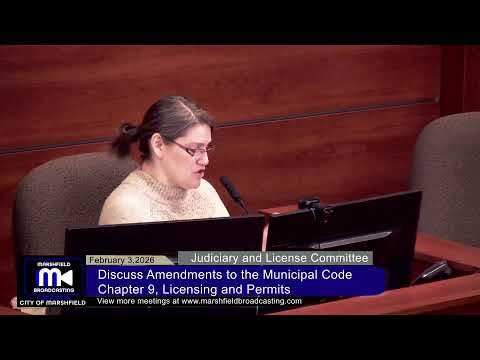
MARSHFIELD, Feb. 3, 2026 — The City of Marshfield Judiciary Licensing Committee voted Tuesday to authorize staff to draft an ordinance amending municipal code Chapter 9 to (1) bring sanitation requirements for Class B (beer-only) liquor licenses into alignment with state statute and (2) change the food-truck licensing period to Jan. 1–Dec. 31.
An unidentified staff member explained the changes and why they are proposed, saying the revisions follow the fee schedule the council adopted for 2026. "Why have them get one license in May that expires in June and have them come back and apply again in July," the staff member asked, describing the practical burden on food-truck operators. The staff member then asked for permission to draft ordinance language consistent with the fee schedule.
The staff member also outlined a mismatch between state law and the Marshfield municipal code on sanitation fixtures at liquor-license premises. According to the staff explanation, state statute requires a handwashing sink, a sanitation sink and a mop sink for combination on-site-consumption licenses but does not impose the same specific fixture requirements on the smaller Class B (beer-only) license. "For the Class B... those requirements are not in place in state statute," the staff member said, presenting two options: keep identical local requirements for all license types or revise local code to follow state statute. The staff member said they had consulted with the Department of Revenue and the Wood County Health Department and with affected business owners.
Committee member Mister Grama moved to align the Class B sanitation standard with state statute — effectively adopting the lesser/statutory requirement where statutorily defined — and to change the food-truck licensing term to Jan. 1–Dec. 31 so the license period matches the annual cycle. "I'd like for the Class B license to align with state statute and do the lesser of the two requirement," Grama said. The motion also gave staff permission to draft the ordinance reflecting those changes. The motion was seconded and carried after members present voted "aye." The presiding officer declared the motion carried.
What this means: if the draft ordinance proceeds to the Common Council and is adopted, food-truck operators would apply once for an annual license covering Jan. 1–Dec. 31 rather than obtain a midseason license and reapply. On sanitation, the committee directed staff to prepare ordinance text that follows state statute for Class B licenses rather than maintaining a separate, stricter local fixture requirement across all license types.
Next steps: staff were authorized to draft the ordinance language. The committee did not set a final hearing or adoption date at Tuesday's meeting; any ordinance would return to the council for further consideration.
The meeting adjourned with no additional business.