Lifetime Citizen Portal Access — AI Briefings, Alerts & Unlimited Follows
Kenmore planning commission opens multi‑meeting review of corner stores, accessory commercial units
Loading...
Summary
Kenmore planning commissioners heard an informational presentation on allowing small neighborhood retail and accessory commercial units in residential zones, discussed a pending state bill (HB 1175) that could require changes, and raised questions about parking, drive‑throughs, housing conversion and business viability.
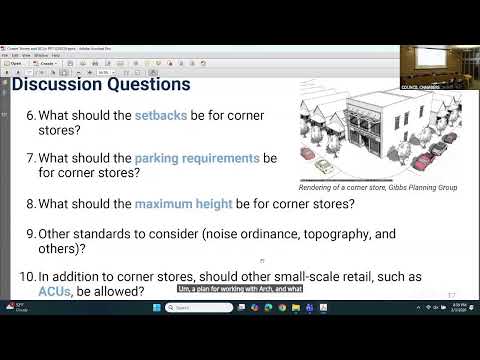
Kenmore, Washington — On Feb. 3, the Kenmore Planning Commission opened a multi‑meeting review of whether to allow small neighborhood retail — often called corner stores — and accessory commercial units (ACUs) in residential zones, hearing an introductory presentation from city staff and a range of questions from commissioners.
Staff planner Britney told the commission the discussion is meant to be conceptual at this stage. “If the bill passes, the city will have two years to implement it,” Britney said, summarizing the pending Washington State House Bill 1175; the measure had passed the House and was under Senate consideration at the time of the briefing. The bill, as described by staff, would allow neighborhood convenience stores and cafes in residential zones, set a 500‑square‑foot minimum for some uses, permit cities to regulate size, parking, signs and hours (while requiring at least 12 consecutive operating hours), and bar nicotine sales in residential zones.
Why it matters: commissioners said neighborhood retail could improve walkability, support small entrepreneurs and distribute services beyond downtown and arterial corridors. Britney noted Kenmore has 2,551 registered businesses, of which roughly 67% are home‑based, and that permitting costs and conditional‑use requirements can be barriers to formalizing or expanding small enterprises.
Discussion focused on compatibility and unintended consequences. Commissioners identified several recurring concerns: parking and impervious‑surface impacts; whether drive‑throughs should ever be allowed (“I really don't want drive thrus,” Commissioner Olsen said); how to prevent a conversion pressure that would turn owner‑occupied housing into investor‑owned rental properties; and the economic viability of small shops in lower‑density neighborhoods.
Commissioner Thompson asked for local evidence before widespread code changes: “I'd be very interested to see what studies have been done in the Northwest,” he said, noting many successful corner‑store examples in the presentation were from dense urban neighborhoods that differ from much of Kenmore.
On scope, commissioners debated whether a ‘‘corner store’’ label should be limited to corner lots or used as shorthand for small‑scale neighborhood retail anywhere on a block. Some members favored a flexible approach that would allow ACUs (smaller, accessory commercial spaces tied to a residence) more broadly while limiting larger neighborhood stores to specific locations or design standards. Staff identified several implementation paths: expand neighborhood business zones in targeted locations; allow ACUs as a use within residential zones with size and operational limits; or adopt the state minimums if HB 1175 becomes law and then decide whether to go further.
Permitting and incentives surfaced as practical levers. Commissioners suggested lowering change‑of‑use fees or reducing conditional‑use burdens to help existing nonconforming or home‑based businesses transition to legal neighborhood retail. Staff noted Bothell was considering a change‑of‑use fee exemption for residential‑to‑commercial conversions as an example of an incentive.
Staff said outreach would follow before drafting any code amendments, including engagement with the Kenmore Business Alliance, the local chamber and other stakeholders. The commission did not take land‑use action or adopt policy at the meeting; staff framed the night as an initial, conceptual discussion and recommended follow‑up research and public outreach before drafting specific code changes.
Next steps: staff will return with options and additional information at future meetings, including analysis of suitable locations, permitting alternatives, design standards, and potential incentives. The commission also discussed balancing this work with an upcoming affordable‑housing strategy that will require staff and consultant resources.