Get Full Government Meeting Transcripts, Videos, & Alerts Forever!
Get email alerts on the Hazard Mitigation topic
No spam. Unsubscribe anytime.
Salem City holds public session on draft Hazard Mitigation Plan; consultants lay out risks and next steps
Summary
Consultants presented a draft update to Salem City's Hazard Mitigation Plan, identified 13 potential hazards including coastal and inland flooding and wildfires, explained scoring methods and funding eligibility through FEMA/MEMA, and invited public comment and a follow-up meeting to prioritize mitigation actions.
Salem City convened a public meeting to review a draft update to its Hazard Mitigation Plan, where consultants outlined the community’s risk profile, draft mitigation goals and the process for submitting the plan for state and federal review.
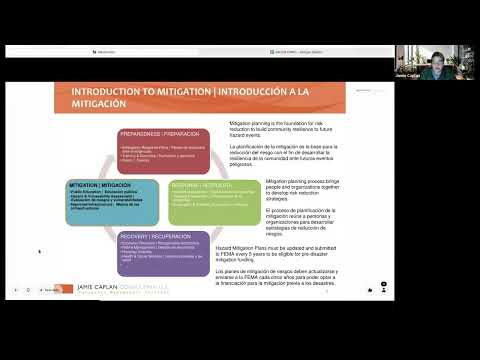
Jenny Caplan, a consultant on the mitigation planning team, said the update follows a standard five-year cycle and aims to identify hazards, evaluate community vulnerability and propose mitigation actions that could make Salem eligible for state and federal mitigation grants. Caplan said, “Por cada dólar que utiliza mitigando esto, aproximadamente se ahorra 6 dólares en gastos por desastres en el futuro,” describing a commonly used national benefit–cost example while noting the ratio varies by hazard and project.
The team presented a six-chapter structure for the plan: a community profile, hazard and risk assessment, capability assessment, mitigation strategy, implementation and maintenance. The consultants said they identified 13 hazards to evaluate and used a scoring framework that includes probability, spatial extent, warning time and duration to prioritize risks.
Presenters highlighted coastal and inland flooding — including FEMA-mapped 100-year flood areas — and explained that hurricane risk has separate water and wind components that affect different parts of the city. They also showed wildfire-risk mapping drawn from U.S. datasets and recent local observations that indicate areas with elevated wildfire probability compared with the prior plan.
Consultant Edwin Brackloade described how the risk assessment combines historical event data with community vulnerability (populations, hospitals, fire stations, roads and natural resources) to model scenarios and estimate potential impacts. The team explained that the analysis uses FEMA methodology and modeling tools.
Speakers stressed nonmeteorological cascading risks such as power outages and urged review of “Plan B” electrical power at critical facilities. The consultants recommended actions ranging from installing or prioritizing backup generators to maintaining seawalls and reinforcing lifeline infrastructure.
Organizers encouraged public participation via an interactive Mentimeter poll and said the draft plan will be published online and made available in print for review. The team announced another public meeting in April focused on specific mitigation actions and said the final local-adopted plan will be submitted to the state emergency management agency and FEMA for review and approval; approval would allow Salem to apply for mitigation funds but would not guarantee grant awards.
The session closed with an invitation for continued feedback and a promise to share where the public can access the draft and related materials. The consultants said the mitigation committee will meet multiple times and that community input will inform the final list of prioritized actions.