Get Full Government Meeting Transcripts, Videos, & Alerts Forever!
Get email alerts on the Immigration Enforcement 287g topic
No spam. Unsubscribe anytime.
Judiciary Committee advances emergency bill to terminate 287(g) jail agreements; passes 12–7
Summary
The House Judiciary Committee on Jan. 28 approved an amendment making House Bill 44 an emergency measure and voted 12–7 to pass the bill as amended, which would require counties to invoke termination clauses and end existing 287(g) immigration-enforcement agreements when the law takes effect.
The House Judiciary Committee voted 12–7 on Jan. 28 to report House Bill 44 as amended, an emergency measure that would require jurisdictions to terminate existing 287(g) immigration-enforcement agreements as soon as the act takes effect.
Staff member Holly, who presented the amendment to the committee, said the change "makes the bill an emergency measure" and adds a provision that "upon the taking effect of this act, any existing immigration enforcement agreements have to be terminated per the termination clause in the agreement." The committee approved the amendment by hand vote and then proceeded to a roll-call vote on the bill as amended.
Supporters told the committee they were acting to preserve public safety and public trust. "This bill is about public safety," Delegate Moon said during floor explanation, arguing that county participation with ICE has "lost the public trust" and that ending the agreements would restore safety and community confidence. Delegate Williams, who also voted yes, said more counties have adopted the agreements since the bill was last before the General Assembly and cited national and local incidents involving ICE behavior as a reason to act now.
Opponents raised concerns about local authority, legal consequences and the adequacy of the record. Several members said many jurisdictions deliberately chose to enter 287(g) agreements and that stripping those local options away could produce litigation and operational difficulties. Delegate McComis (asking procedural questions) and others warned the change could prompt lawsuits by counties, sheriffs or federal actors. "We're gonna see litigation everywhere," one committee member said, urging caution.
The committee also sought and received clarifications about implementation. Delegate Phillips noted that many of the instruments appear to be memoranda of understanding rather than formal contracts and said the MOUs often include termination language allowing local law-enforcement entities to end participation. On detainees in transition, the committee was told that existing federal detainer rules remain in effect: "If there's an active detainer on them, they've already gone through the system ... ICE would have 48 hours to come get them," a member responding to the question said.
Members cited specific jurisdictions in their explanations: panelists and members referenced Garrett, Saint Mary's, Washington, Cecil, Harford, Frederick and Wicomico counties as places that have adopted 287(g)-type agreements since the measure was last considered. Some speakers said counties had sufficient notice that the General Assembly was likely to revisit these agreements; others said local public-safety choices should be preserved.
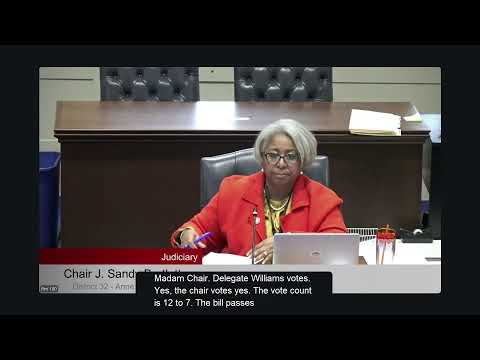
After members offered brief explanations for their votes, the chair announced the committee's tally: 12 ayes, 7 nays. The chair then closed the vote session. The committee's action reports the bill favorably as amended; the transcript ends with the chair thanking members for their candor.
What the amendment does and what remains unclear
The amendment makes HB 44 an emergency measure so that, if enacted and signed, the termination requirement would take effect immediately upon the bill becoming law rather than on a later scheduled date. Committee discussion in this session emphasized that the practical timing depends on when the legislature completes action and when the bill is presented to and acted on by the governor. Committee members discussed differing interpretations of the governor's review window in the current legislative calendar.
The committee's passage of HB 44 as amended does not by itself terminate specific agreements; it would require jurisdictions to invoke termination clauses in their own MOUs or agreements. Members repeatedly noted that the content of existing agreements and the presence or strength of termination clauses vary by county and that those contractual details could determine how quickly a termination could occur and whether litigation would follow.
Next procedural step
On Jan. 28 the Judiciary Committee reported HB 44 favorable as amended by a 12–7 vote. The committee record in the transcript does not include subsequent floor action or any court or implementation outcomes.