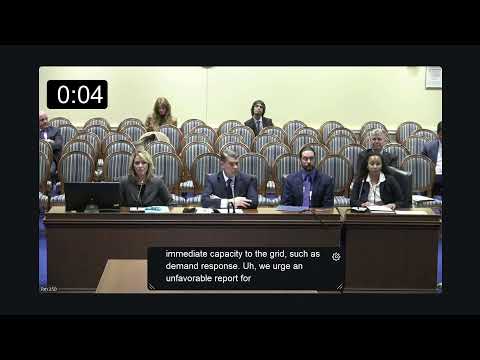
Committee hears HB 40 to require transmission owners to evaluate grid‑enhancing technologies
Loading...
Summary
HB 40 would require utilities to evaluate advanced transmission technologies (ATTs) and high‑performance conductors to reduce congestion and potential new transmission construction; supporters said ATTs can unlock ~20% more capacity and save ratepayers; a resident raised EMF/health concerns.
Delegate Lori Charcutian presented HB 40 to require transmission owners to identify congestion, quantify costs to ratepayers, and evaluate advanced transmission technologies (ATTs) — such as dynamic line rating, topology optimization, and high‑performance conductors — as alternatives to building new overhead transmission. The sponsor said using ATTs could reduce the need for new transmission by an estimated 20% in some locations and lower ratepayer costs by limiting rate‑based capital expansions.
Industry and advocacy witnesses — including Nathan Shreve (consulting for the Watt Coalition and Amp Coalition), Katie Meddle (Advanced Energy United), and Adam Dubinsky (Land of Liberty Coalition) — strongly supported the bill, citing studies that show high benefit‑cost ratios and near‑term congestion relief. David Lapp (Office of People's Counsel) also urged a favorable report, noting transmission costs have doubled since 2015 and are embedded in customer bills.
Speakers emphasized state‑level measures must be written carefully because transmission and rates are subject to FERC jurisdiction; the sponsor and PSC representatives discussed technical amendments to align state review without overstepping federal authority. Several local stakeholders, including the Maryland Farm Bureau and a residents’ speaker, supported the bill while urging transparent local engagement and safeguards. One resident raised concerns about electromagnetic fields (EMF) and sought amendments to require studies or limits on reconductoring impacts near inhabited areas.
The committee discussed implementation, reporting requirements, and interactions with PJM/FERC processes. The Public Service Commission indicated technical, friendly amendments to improve implementation.