
Regional transit agencies brief committee, warn of capital shortfall and outline modernization plans
Get AI-powered insights, summaries, and transcripts
Subscribe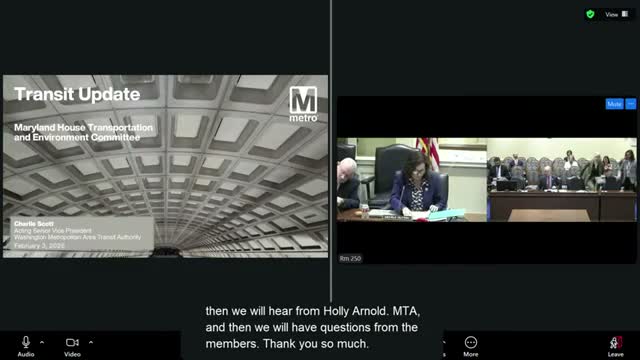
Summary
WMATA and the Maryland Transit Administration described ridership gains, safety improvements and major capital projects — and urged coordinated funding as WMATA’s 2018 bond capacity runs out in FY2029. MTA detailed a $1.4 billion light‑rail modernization program and Purple Line progress.
Charlie Scott, acting vice president of the Washington Metropolitan Area Transit Authority, told the Environment and Transportation Committee that Metro has recovered significant ridership and safety performance but faces a looming capital shortfall unless state and regional partners act.
Scott highlighted industry recognition and usage figures, saying the system averaged nearly 469,000 weekday trips systemwide last year and that rail ridership in Maryland reached about 65,000 daily trips in December 2025. He credited service and safety work with major improvements, including a reported 82% reduction in fare evasion on rail and the return to automatic train operation on all lines for the first time since 2009.
Scott warned that Metro’s current capital program depends on bonding capacity created by a 2018 funding package and "that bond capacity runs out in FY29," projecting roughly an $800 million reduction in the agency’s near‑term capital capacity. "The ask of Maryland and of the entire region is to come together to identify funding, to support improved funding in our CIP," he said, urging cooperation among Maryland, Virginia and the District.
Holly Arnold, administrator of the Maryland Transit Administration, summarized MTA priorities and projects funded in the most recent state budget. Arnold said the agency is advancing a $1.4 billion light‑rail modernization program to replace vehicles, upgrade signals and invest in stations and maintenance facilities. She reported Purple Line civil construction at about 87% completion and said MTA expects to finish major civil work this year and begin testing next year.
Arnold also described safety and equity measures: a rider code of conduct and exclusion policy enacted after recent legislation, naloxone availability at metro stations, and fare policy changes that now allow children 12 and under to ride free and extend the free transfer window to two hours. She noted the MARC Student Saver pilot sign‑ups and ongoing work to improve Mobility paratransit scheduling software.
On bus service, MTA and Metro officials said they are piloting zero‑emission buses but cautioned that industry reliability and battery performance vary by route; MTA reported seven ZEBs entered service in 2024 and expects a larger fleet by 2027, with some earlier vehicles temporarily sidelined while manufacturers supply fixes.
Committee members pressed agencies on timelines for MARC Brunswick line expansion, fare reciprocity and accessibility. Arnold said Brunswick is the highest opportunity for MARC service expansion, but that progress depends on funding and agreements with CSX; she said MTA will pursue federal opportunities and that a Silver Spring turnback design (30% funded) is under way. Both agencies said the Purple Line and MTA services will be compatible with regional contactless fare systems including TapRide Go.
The briefing closed with committee requests for follow‑up data on corridor prioritization, facility projects such as Martin State Airport improvements, and additional detail about how unspent funds are carried forward in agency capital programs.
The committee moved on to a Vision 0 briefing; no formal actions were taken during this transit briefing.