South Essex Sewerage District outlines $400 million resiliency and sludge challenge to Salem committee
Loading...
Summary
At a Salem SERC meeting, David Michaelson, executive director of the South Essex Sewerage District, reviewed plant operations, rising sludge disposal costs driven by PFAS restrictions, and a resiliency‑focused 20‑year capital plan with roughly $400 million needed in the first 10 years.
David Michaelson, executive director of the South Essex Sewerage District, told Salem’s Sustainability, Energy and Resiliency Committee that the regional wastewater agency treats roughly 25 million gallons of wastewater a day for about 190,000 residents and businesses across five member communities (Beverly, Danvers, Salem, Peabody and Marblehead).
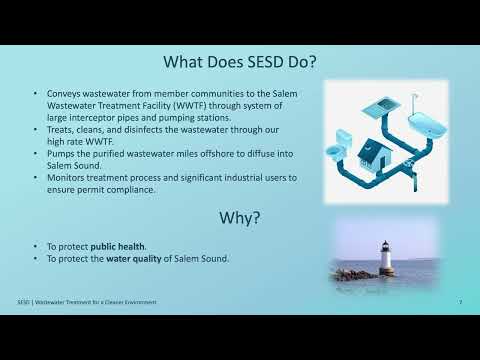
"We provide wastewater treatment services to a 190,000 people, residents and businesses, and 5 or 5 member communities," Michaelson said, and described SCSD’s interceptor and pump‑station network that conveys sewage to the Salem plant and then discharges treated effluent offshore through a diffuser.
Why it matters: SCSD operates under a federal wastewater discharge permit and must meet strict flow and water‑quality limits while keeping rates and assessments stable for its five member communities. Several long‑running infrastructure items and new regulatory pressures are converging and will drive near‑term capital and operating decisions.
Operational and performance details: Michaelson said the plant’s design limit is about 29.7 million gallons per day, with recent averages near 24.5 MGD (2024 was wetter than average). He reported 2024 effluent averages of about 19 mg/L TSS and 12 mg/L BOD and described routine monitoring (composite sampling every 48 hours) the district uses to apportion costs among member cities.
The treatment process, he said, uses underground primary clarifiers, oxygen‑based reactors for activated‑sludge treatment and secondary clarifiers. The district recently relined aging primary clarifiers in a multi‑year rehabilitation that Michaelson estimated cost roughly $20,000,000.
Sludge, PFAS and disposal costs: A major focus of the presentation was residuals management. Michaelson explained SCSD combines primary and secondary sludge, adds polymer, and dewaters the solids to roughly 22–23% solids before hauling. "We are a passive receiver of PFAS," he said, and noted that land‑application bans in Maine and Connecticut and expected Massachusetts legislation have reduced regional outlets for biosolids.
He told the committee the district currently produces on the order of 29,000–30,000 tons of residuals annually and relies on a long‑term hauling contract with Casella. Because many composting and land‑application outlets have closed, Michaelson said disposal markets are tightening and SCSD expects residuals handling costs to increase substantially—he estimated disposal costs could rise by roughly 50% when the next contract is bid.
Technology and short‑term responses: Michaelson said no widely proven PFAS destruction technology has been deployed at scale for wastewater residuals. He described pilot tests under DEP sponsorship (gasification, pyrolysis and other approaches) and said SCSD will send a small sample to a California pilot to test destruction methods. In the nearer term the district plans to replace 25‑year‑old dewatering equipment to reduce hauled volume and is considering regional solutions and drying/thermal options, though those are capital‑intensive.
Energy and resilience measures: Michaelson reviewed two decades of energy‑efficiency work and a cogeneration plant that recovers heat but runs on natural gas; he noted reliability and parts‑supply issues with the cogeneration unit. SCSD is deploying demand‑response programs with ISO New England as a revenue source and has signed a power‑purchase agreement to mount a 240‑kilowatt solar array on a clarifier.
Coastal risks and capital plan: On resiliency, Michaelson described a 2021 resiliency review of the vulnerable Beverly pump station (Water Street) and said SCSD has purchased removable floodgates for short‑term protection. He also flagged a set of site‑specific vulnerabilities (garage doors at the effluent pump station, high‑priority siphon and force‑main segments) the district is monitoring.
Michaelson said SCSD is finalizing a 20‑year comprehensive wastewater management plan with a resiliency chapter but will focus on the first 10‑year horizon for immediate needs. "It looks like it's gonna be in a range of $400,000,000 for the next 10 year horizon," he told the committee, and said the district is discussing financing, municipal support and possible special legislation to address Prop 2 1/2 constraints. He said SRF funding is oversubscribed and SCSD is exploring alternatives such as WIFIA.
Committee followup and next steps: Committee members raised questions about stormwater and high‑intensity rainfall impacts, potential on‑site flooding, and how projects intersect with neighboring property changes. Michaelson said some assets are upgradient and that most pump stations are tidal so tides—not just rainfall—drive many risks; he said SCSD is lining up presentations to city councils and legislative stakeholders to build support.
The meeting ended after a member motion to adjourn was made and seconded; no formal roll‑call vote was recorded.