
Knoxville council denies appeal, upholds BZA variance for 962 North Gallaher View Road
Get AI-powered insights, summaries, and transcripts
Subscribe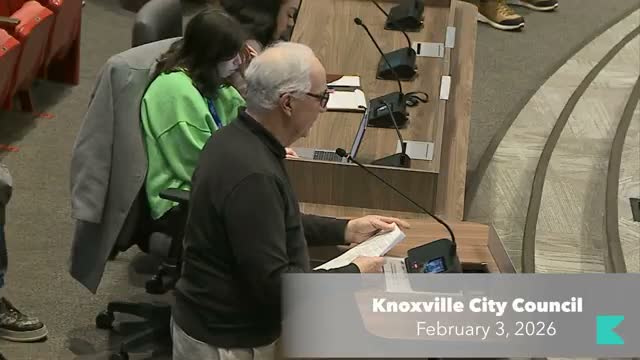
Summary
After extended legal argument and public hearing, Knoxville City Council voted 5–4 to deny an appeal challenging a Board of Zoning Appeals variance that reduced the minimum lot width for townhome units at 962 North Gallaher View Road, allowing the developerto pursue a 32-unit townhouse plan.
The Knoxville City Council voted 5to9 to deny an appeal of a Board of Zoning Appeals decision on a contested townhouse project at 962 North Gallaher View Road, effectively leaving in place a BZA variance that reduces the minimum lot width per townhome from 20 feet to 9.5 feet.
The appeal was filed by the West Hills Community Association and presented by attorney Larry Silverstein, who told the council the BZA’s November decision “failed to discuss the zoning ordinance standards or make findings” required under Article 16.3 and state law and therefore was “illegal and outside of its authority.” He urged council to reverse the BZA and deny the variance.
Representatives for the owner, Mainland Companies, and the applicant argued the lothas a unique combination of frontage, topography and stormwater constraints that justify the variance. Attorney Ben Mullins said the lot’s frontage and internal street orientation required an interpretation of how the code’s lot-width standard applies and maintained the project meets the RN-4 intent. James Lennon, who identified himself as the owner representative for Mainland, said the company seeks to build 32 for-sale townhomes and that the project is appropriate at the intersection of two arterial corridors.
Council members debated legal standards at length, focusing on the five variance criteria in Article 16.3, whether those criteria require a showing that the ordinance deprives an owner of any reasonable use of the land, and the relationship between city ordinance language and the state enabling statute. Planning staff told council that, under the current interpretation of lot width as frontage-oriented, the parcel could support 15 townhomes without a variance.
Council members also discussed housing supply and finance: the applicant said roughly $1,000,000 of site work is required and that a 15-unit version would not be financially viable, while 32 units would produce lower unit prices than the smaller scheme. Yet several council members emphasized the councilmust apply the legal variance criteria rather than making a policy judgment about housing supply.
After deliberation, the council took a roll-call vote and the mayor announced the motion to deny the appeal carried 5 in favor, 4 opposed. The outcome means the BZA decision granting the variance remains in effect and the owner may proceed to the next steps in site development and planning review under that allowance.
The councilrecord contains extensive legal argument on both sides, and several members referenced the Reed v. Town of Lewisville Court of Appeals decision during their comments. Councilmembers and staff also raised questions about whether variances "run with the land" and how subsequent site-plan changes would interact with a standing variance. The council did not adopt new code changes at the meeting; the decision addressed only the appeal before it.
The meeting moved on to other agenda items after the vote; the council did not take further action on the Gallaher View property beyond the ruling on the appeal.