Get Full Government Meeting Transcripts, Videos, & Alerts Forever!
Get email alerts on the Strategic Priorities topic
No spam. Unsubscribe anytime.
Carmel-by-the-Sea council narrows 2026 strategic priorities, emphasizes infrastructure, finance and wildfire work
Summary
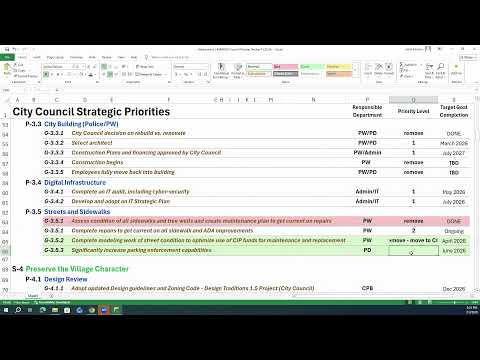
Council reviewed a staff-marked priorities worksheet and assigned levels to items including financial reporting and dashboards, ERP implementation, paid parking/parking management, beach repairs, climate adaptation, wildfire mitigation and an evacuation drill; several items were removed as complete.
City Administrator Brandon presented an updated, color‑coded priorities worksheet and led the City Council through a line‑by‑line review of the city’s strategic priorities for 2026. The document flagged completed items, new proposals and title changes and asked council members to assign priority levels and suggest items for a future projects list.
Council members focused early discussion on budget and reporting clarity, with Councilmember Hans arguing for improved management metrics and Councilmember Boothe urging a departmental view of staff capacity. Brandon explained the color key: pink items were complete and proposed for removal, green were new, yellow were retitled and clear items required a priority assignment. “This strategic priorities list is really what that song list is,” Brandon said, describing the mayor–manager relationship and staff’s role in executing council directions.
The council set a priority 1 for an enterprise resource planning (ERP) project that would modernize HR, payroll and finance systems after staff and several council members said the current systems are disparate and inefficient. “Internally, it’s a 1 for us because what we’re using is extremely inefficient,” Marissa (city staff) said, urging council to authorize meaningful progress this year so implementation can begin.
On financial reporting, members debated language and scope. Some favored expanding reporting to include operational KPIs; others warned against an open‑ended directive that could overload staff. Council ultimately removed two items staff marked done, approved advancing a public‑facing CIP dashboard and left the wording on report improvements to staff with council input.
Parking and revenue topics drew extensive public comment and council debate. Council discussed whether to treat parking as a revenue option or a parking‑management program tied to enforcement and congestion reduction. Councilmember Dramoff urged use of the term “parking management” to emphasize congestion control and enforcement, while others emphasized the potential revenue benefit of paid parking. Council agreed to keep a paid‑parking/parking management item at a level 2 priority to study options.
Beach infrastructure, including stair and outfall repairs, was set as a high priority following staff reports about escalating erosion and the need for a longer‑term coastline implementation plan tied to the Climate Action and Adaptation Plan. The council directed staff to append plan tasks to the main priorities worksheet for visibility and to bring dates back to council with departmental input.
Wildfire mitigation items were prioritized: council collapsed related actions to focus on defensible‑space rules and home‑hardening, approved bringing a vetted, prioritized list of fuel‑mitigation tasks to council for review, and set a May 2026 target for a citywide evacuation drill. Councilmembers emphasized community outreach and clarification of roles for implementation.
The meeting also advanced several administrative next steps: staff will return next month with draft dates for items where target completions were unclear; the council asked department heads to specify capacity by department; and council signaled interest in a Shoreline/CIP appendix to track longer‑term plan tasks. With work still remaining, the council set an approximate curfew to reconvene priority item deliberations at the next meeting.
The council closed the item by instructing staff to update the worksheet in real time during the meeting and to return with a clean priorities list, appended plan tasks, and recommended target dates for items that require external approvals or large consultant studies. The council will continue integrating the prioritized items into the upcoming budget process.