Get Full Government Meeting Transcripts, Videos, & Alerts Forever!
Get email alerts on the State Budget topic
No spam. Unsubscribe anytime.
DLS: Governor's $70.7B FY27 proposal narrows near-term gap but shifts costs to local governments and special funds
Summary
Department of Legislative Services told the Judiciary Committee the governor's $70.7 billion FY27 proposal narrows the near-term structural gap but relies on nearly $600 million in fund transfers and moves about $39 million of teacher retirement costs to counties, raising local budget pressures.
The Department of Legislative Services told the Judiciary Committee on Jan. 29 that the governor's proposed fiscal 2027 budget totals about $70.7 billion and narrows the structural shortfall for FY27 to under $400 million. "He's leaving $2,200,000,000 in the state's rainy day fund," the presenter said, and the budget projects a $108,000,000 general fund cash balance at year-end.
Why it matters: The administration's plan improves the immediate fiscal outlook but does so in part by tapping special funds and shifting recurring costs, creating risks in later years. DLS officials warned the state still faces a growing structural deficit in subsequent years that could reach several billion dollars.
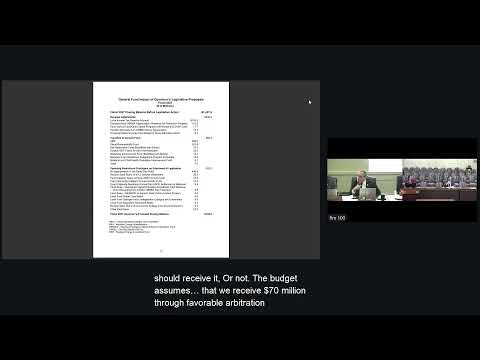
What DLS reported: The briefing said about $1.5 billion of the governor's balancing actions require legislation; without those actions the state would face roughly a $1.4 billion shortfall. Revenue choices include selectively —decoupling— from certain federal business tax changes to generate an estimated $130 million. Nearly $600 million of transfers to the general fund are proposed, led by the Strategic Energy Investment Fund.
Local impacts and program changes: The presenter said the administration proposes shifting roughly $39 million in retirement-related costs (teachers, librarians and community-college staff) to county governments beginning in FY27, a recurring obligation that will increase local budgets. DLS also flagged level funding of a disparity grant that reduces expected growth and caps on community-college formula growth designed to save about $21 million statewide.
Health and human services: DLS highlighted that the budget proposes no rate increases for many Medicaid and human-services providers even as state employees receive a 1.5% cost-of-living adjustment. The briefing noted a roughly $170 million difference between the administration's behavioral-health Medicaid assumptions and the legislative services forecast, driven by the administration's expectation of much lower growth.
Funding swaps and initiatives: The governor would use fund swaps and one-time balances to smooth FY27, including drawing down the Strategic Energy Investment Fund and using bonds to support Bay Restoration Fund activities while transferring $70 million in Bay fund cash to the general fund. The budget also includes initiative spending for legislative priorities and economic development incentives, among them proposals tied to IONQ and AstraZeneca.
Outlook: DLS said the governor's plan eases FY27 pressures but leaves the state with larger structural gaps in later years, and warned that several items (federal policy changes, DOT audit recoveries, and the Child Victims Act) could materially affect future budgets. The department said it will continue to refine forecasts as new data arrive.