Get Full Government Meeting Transcripts, Videos, & Alerts Forever!
Get email alerts on the Transit Central Subway topic
No spam. Unsubscribe anytime.
Supervisors hear operational progress and start planning steps for Central Subway extension to North Beach
Summary
The Land Use & Transportation Committee received SFMTA and SFCTA briefings on Central Subway operations — citing rising ridership and signal-priority gains — and discussed next steps to resume an alternatives study and environmental work for a potential extension to North Beach and Fisherman’s Wharf.
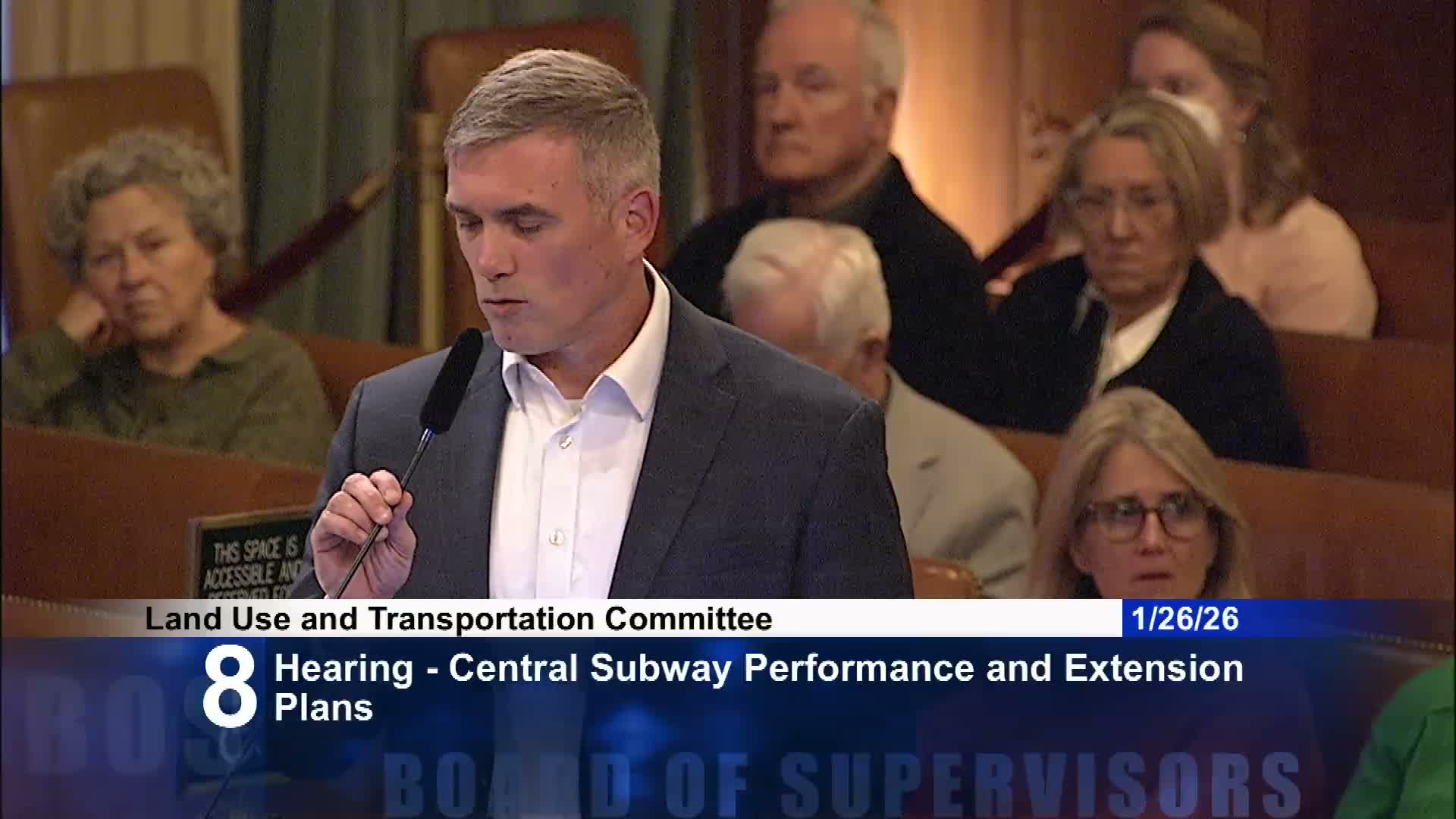
Supervisor Aaron Sauter convened the committee hearing on the Central Subway on Jan. 26, asking SFMTA and SFCTA to report on current performance and the feasibility of a northern extension to North Beach and Fisherman’s Wharf.
SFMTA Chief Planning and Delivery Officer Sean Kennedy said the T line now averages over 20,000 riders a day, making it the agency’s second-highest rail ridership line, and argued the line is inducing new trips into the system rather than simply shifting existing bus riders. Kennedy highlighted near-term operational improvements already underway: a transit lane on 4th Street that cut travel time on a key segment by about 20%, and a pilot transit-signal-priority program that showed up to a 35% travel-time improvement where tested. He also said vertical-transportation (elevator/escalator) uptime at deep stations is now in the high-80s to low-90s percentage range after process and parts-supply changes.
From the planning and funding side, Rachel Hyatt, Deputy Director for Planning at the San Francisco County Transportation Authority, outlined the role of long-range planning and local financial commitment in making projects competitive for federal grants. Hyatt said prior studies (including a 2015 concept study) found strong public support for a northern extension and noted that roughly half a mile of tunnel already exists north of Chinatown — work that could reduce construction cost compared with a wholly new tunnel. But she and Kennedy cautioned that major near-term work is constrained by the agency's operating budget pressures, and that finishing an alternatives analysis and funding an environmental review would require multi‑million dollar planning investments and a clear local match.
Elected officials pressed agency staff on concrete timelines, cost estimates, and lessons learned from the original Central Subway project. Kennedy said a focused alternatives study would likely cost in the low millions and that an environmental review would be a separate, multimillion‑dollar step. Program director Albert Ho summarized lessons from the program’s post‑construction evaluation, advising clearer delivery methodologies, early scope definition to limit scope creep, and careful procurement strategies to reduce cost and schedule risk.
More than two dozen members of the public and representatives of business, neighborhood, and transit-advocacy groups spoke during public comment. Speakers from North Beach, the Marina and Fisherman’s Wharf urged advancing planning and a phased approach that could add a station at Washington Square Park without waiting for a full extension; tourism and business leaders emphasized the potential economic benefits to the northern waterfront. Opponents and independent analysts urged more attention to cost control, alternative surface options, and prioritizing transit-priority improvements where they would deliver immediate reliability gains.
Supervisor Sauter and SFCTA staff said about $370,000 in remaining study funding has been identified and that the committee can use Prop L and regional grant programs to seed a resumed alternatives analysis. The committee voted to file the hearing and directed staff to continue work on near-term operational fixes and to advance the planning work needed to position the extension for future federal and regional funding.
The committee did not make any construction commitments; next concrete steps identified were completion of an alternatives analysis, targeted environmental scoping, and assembling a local funding match to compete for federal capital grants.