
Residents urge Lake Forest to adopt guardrails on federal immigration enforcement and press council on local safety and contracts
Get AI-powered insights, summaries, and transcripts
Sign Up Free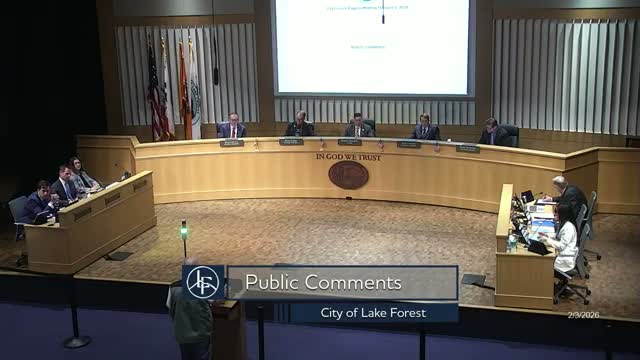
Summary
Dozens of residents urged the Lake Forest council to adopt language like King County to limit local impacts of DHS and ICE operations; speakers also raised neighborhood safety, criticized a proposed $500,000 security‑guard contract and urged code enforcement on illegal businesses and street repairs.
Lake Forest — Public comment dominated much of the Feb. 3 meeting as residents pressed the City Council to take local action on federal immigration enforcement and raised multiple concerns about neighborhood safety, municipal enforcement and proposed security spending.
Several speakers, including Jay Cost and Mike Davison, urged the council to consider language modeled on recent King County resolutions that call for guardrails in federal DHS funding bills. Amy Stevens read a draft resolution on behalf of community supporters outlining proposed protections — such as barring enforcement at sensitive locations, requiring warrants for arrests by immigration authorities, independent investigations into alleged abuses, and body‑worn cameras — and asked the clerk to send copies to Washington’s congressional delegation.
Olivia Bain, a teacher, said a University of California, Irvine working paper led by Professor William Lester estimated a nearly $59 million loss in Orange County economic output over eight weeks after intensified enforcement; she said the study included responses from businesses across Orange County, including Lake Forest.
Residents also used public comment to press on local matters. Andrew O'Connor repeatedly criticized a proposed sports‑park security contract, claiming a prior contract with Panther Security for about $213,000 "never worked" and objecting to a new proposed scope priced at roughly $500,000. O'Connor told the council he had checked payments and said the company did not provide the services he expected. Deputy city staff responded that contract scopes can be adjusted and that staff have mechanisms to address vandalism and vagrancy at parks.
Other commenters raised neighborhood quality and code enforcement concerns. Brian McMillan urged enforcement against illegal businesses and cited municipal code provisions assigning abatement responsibilities to the director of community development (Gail Ackerman was named in public comment); Frank Denny asked Public Works to inspect and schedule resurfacing on Regency Avenue, and Bob Holtzclaw requested help with a person camping at a bus stop near El Toro Road.
Council members listened, clarified procedural limits for staff responses during public comment, and said staff may contact speakers who left contact information for follow‑up. Several council members thanked residents for civility and urged continued engagement.
No formal council action on federal immigration policy took place at the Feb. 3 meeting; residents asked the council to consider similar language at a future meeting, and staff noted the clerk would forward materials to federal representatives on request.