
Committee reviews H.585 governance changes and new executive‑compensation reporting for nonprofit hospital insurers
Get AI-powered insights, summaries, and transcripts
Subscribe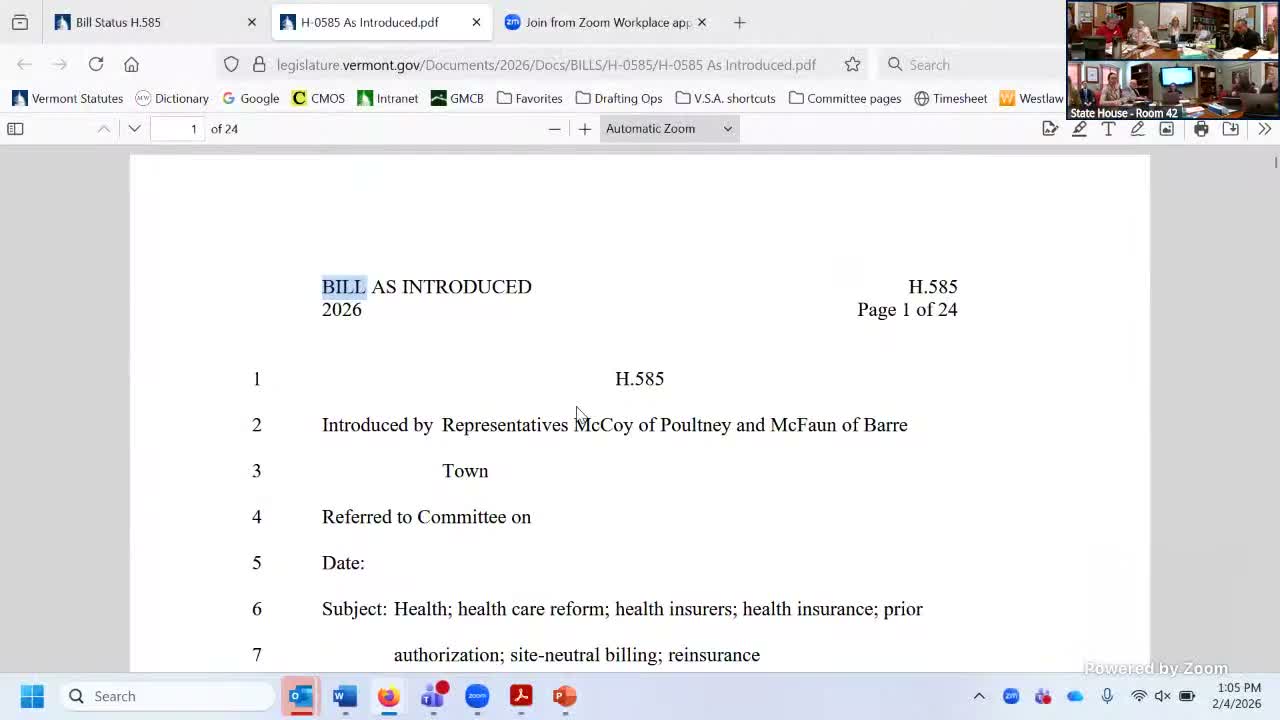
Summary
Lawmakers and regulators examined proposed H.585 changes that would add governor‑appointed public representatives to hospital‑service corporation boards and require hospitals’ insurers to file detailed executive‑pay benchmarking and bonus criteria with the state regulator before approving pay changes.
The committee on H.585 reviewed new governance and executive‑compensation provisions aimed at increasing oversight of nonprofit hospital service corporations, the kind of entity that includes Blue Cross and Blue Shield of Vermont.
Jen Harvey of the Office of Legislative Council laid out the revisions, including a new statutory definition of "representative of the public," rules setting initial staggered terms for governor‑appointed members, and a requirement that compensation committees include at least two voting representatives of the public. The bill moves existing board‑composition rules into a new section (45‑13) and requires existing corporations to amend bylaws and file them with the commissioner of Financial Regulation (DFR) by 2026‑09‑01.
Commissioner Sampson’s office told the committee the reporting requirements are intended to give regulators the data needed to evaluate executive pay. A DFR representative said the statute would require hospital service corporations, "on or before 07/01/2026 and prior to approving any changes to the compensation of any executive," to file a sworn statement from the board chair and president that includes all compensation benchmarks, detailed peer‑group data, and the specific criteria used to pay bonuses. The DFR official said the department needs access to the underlying peer‑group entities so staff can "recompute the benchmarks" and judge whether the corporation’s chosen comparators are appropriate.
Courtney Harness, representing Blue Cross and Blue Shield of Vermont, told the committee the insurer supports accountability but asked the panel to clarify how the governance changes would improve affordability or efficiency for Vermonters. Harness said the company already uses an independent compensation consultant, naming SullivanCotter, and that executive salaries and rate filings are public. "There is not an executive at Blue Cross and Blue Shield of Vermont that received a 40% raise last year," Harness said, disputing an earlier claim in testimony.
Several legislators raised concerns about the appointing process for the governor‑appointed representatives, asking whether a nominating committee—similar to the Green Mountain Care Board’s model—should vet candidates to prevent politicized or nepotistic appointments. Committee members also asked whether appointees who are administration officials could present conflicts of interest; DFR witnesses said conflict‑of‑interest rules and confidentiality obligations would limit those placements.
The committee did not take formal action on the sections. Members asked DFR and Blue Cross for additional materials: the department’s expectations for peer‑group documentation and for the insurer to provide more detail on its benchmarking process and public filings. The hearing adjourned to allow a floor session that was scheduled to begin shortly after the committee reconvened.
Ending: The committee requested follow‑up materials and modeling from DFR and Blue Cross; no vote was taken on the provisions during the session.