
District leadership outlines data-driven instruction and PLCs, trustees press link to MCAS results
Get AI-powered insights, summaries, and transcripts
Subscribe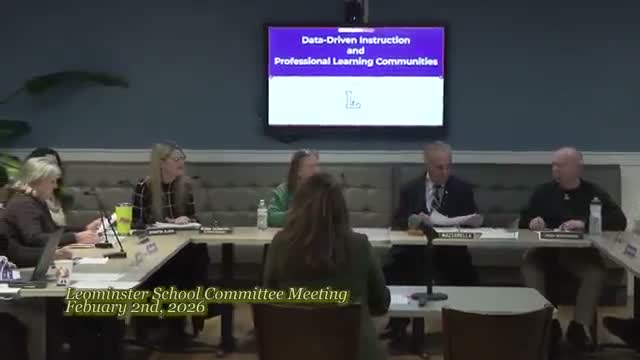
Summary
District leadership described professional learning communities and a tight data cycle using exit tickets and assessments to adjust instruction; trustees questioned why classroom gains are not always reflected in MCAS scores and sought measurable, time-bound outcomes.
District leaders presented a data-driven instruction model Feb. 2 that centers on professional learning communities (PLCs) and short assessment cycles designed to surface misconceptions and adjust teaching in near real time.
Janine, introduced by the superintendent as the presenter for the district leadership team, described the approach: "data driven instruction is just making instructional decisions based on data," she said, and outlined a cycle of assessment, analysis, adjustment and monitoring in which teachers use both formative 'exit tickets' and larger assessments (iReady, MCAS) to guide instruction.
Presenters and committee members gave examples: elementary classes focusing on specific writing skills set granular goals; middle schools use exit tickets to check comprehension daily and then adjust the next day's teaching. Janine described the practical loop: teachers analyze student work in small data moments, try an intervention across classrooms and then reconvene to see whether the quick formative checks show improvement.
Trustees pushed for clearer evidence that the cycle affects summative testing. The chair and other members said classroom practice appears stronger than test results indicate and asked whether the district can show year-end growth attributable to the new processes. Janine and the superintendent said the model is intended to produce measurable growth but acknowledged some students and cohorts lag in standardized results and that comparisons must account for cohort differences.
Discussion touched on technology and artificial intelligence as supports. Staff said some software automates assessment analysis and that preserving time for teacher collaboration—rather than shifting heavy manual work onto teachers—is essential. Committee members requested follow-up showing whether the ‘‘OODA’’-style loop (observe, orient, decide, act) is becoming faster and producing measurable gains.
The presenters committed to returning with examples of specific interventions, outcomes from short-cycle assessments and trend data at a future meeting. Trustees said they expect to see evidence of student growth by the end of the school year tied to these practices.