Get Full Government Meeting Transcripts, Videos, & Alerts Forever!
Get email alerts on the Rezoning Davies Imperial topic
No spam. Unsubscribe anytime.
Planning panel forwards Davies Imperial rezoning to council with restrictive covenant
Summary
The commission forwarded CP26-03, a petition to rezone three parcels at 1175 State Street for a proposed $15 million Davies Imperial thermoplastics plant, to the Common Council with a favorable recommendation conditioned on a use-restriction covenant; staff flagged buffers, traffic study completion, and additional permits as outstanding.
The Hammond Planning Commission voted to forward CP26-03 — a petition from Davies Imperial Coatings Inc. to rezone three parcels, including 1175 State Street, from R-1U (urban single-family) to I-1 (light manufacturing) — to the Common Council with a favorable recommendation conditioned on a restrictive use covenant and outstanding technical reviews.
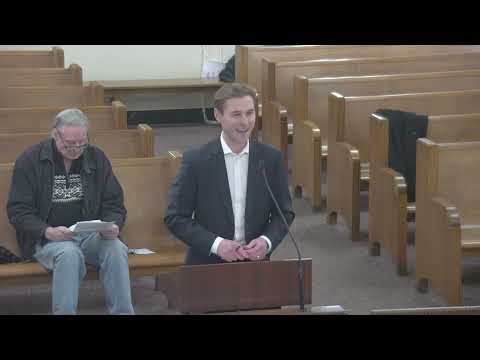
Jack Farino, a representative of 219 Development Services, told the commission the project is a $15,000,000 ground-up development for a 50,000-square-foot thermoplastics plant that would shift Davies Imperial from wet road-paint operations into a dry thermoplastics production process. "They're a multi generational company who's been in the city of Hammond for decades," Farino said, adding the project would bring about 25 initial jobs, eventually growing to more than 40.
A resident, Charles Pazdash of 1144 Indiana Street, asked at the public hearing, "Are they planning on building a factory next door to my house?" Commission members and staff clarified the site is on State Street and that Pazdash received notice because his property lies within a 300-foot notification radius.
Staff (Brian Poland) presented a detailed review and a draft use-restriction covenant tailored to the site, noting civil and technical reviews remain outstanding (city engineering, HDM, water, fire and sanitary district) and that the city is completing a traffic study to address lane reconfiguration and truck routing. Poland said the covenant removes several I-1 permitted uses judged inappropriate next to residential areas and specifies that certain processed materials may be used without triggering an I-2 classification; any other chemicals or discharges would require additional state or federal permits and review by relevant enforcement bodies.
Commissioners voted by roll call to forward the petition along with the use-restriction covenant; the motion passed 9-0. The commission also accepted the staff report as preliminary findings of fact (vote recorded as passing with 9 ayes and recorded abstentions noted in the minutes for that motion). The commission’s favorable recommendation is conditioned on finalization and recording of the restrictive covenant and completion of outstanding technical reviews; the matter now moves to the Common Council for final action.