Get Full Government Meeting Transcripts, Videos, & Alerts Forever!
Get email alerts on the Land Use Solar topic
No spam. Unsubscribe anytime.
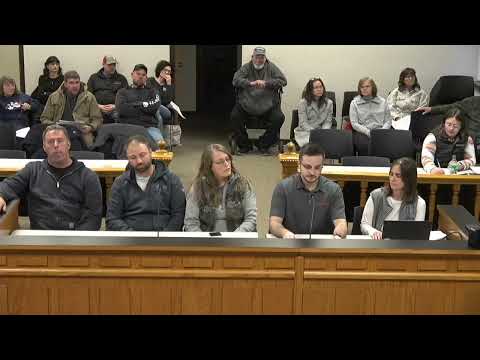
Houston County planning panel recommends denial of 5 MW Caledonia solar permit
Summary
After hearing hours of testimony, the Houston County Planning Commission voted to recommend denial of a conditional use permit for a proposed 5-megawatt, ground-mounted solar project in Caledonia Township, citing inconsistency with the county comprehensive land use plan and a lack of local ordinance language addressing large commercial solar arrays.
The Houston County Planning Commission voted to recommend denial of a conditional use permit for a proposed 5-megawatt ground-mounted solar project on a 109-acre parcel in Caledonia Township, after commissioners said the proposal conflicted with the county’s comprehensive land use plan and that the county lacks an ordinance governing large commercial solar installations.
Planning Commission member Larry Gaustad said the staff’s finding that the project ‘‘is not consistent with the plan’’ guided his vote. Commission members recorded a majority in favor of recommending denial: Gaustad, Franklin Hahn, Eric Johnson and Chase Munson voted to recommend denial; Josh Gran and Rich Shield opposed the recommendation. The commission’s recommendation will go to the Houston County Board for a final decision.
The application, submitted by 1 Energy Development on behalf of AC 4 Farms LLC, proposed a roughly 24-acre array within a 109-acre property that company materials said would produce about 10,000,000 kilowatt-hours a year—equivalent, the applicant said, to the annual electricity needs of more than 1,000 homes. 1 Energy presenter Braden Dumond described the project as a distribution-connected site intended to serve the Caledonia substation and to be paired with a 30-year power purchase agreement with My Energy Cooperative.
Ken Whitcomb, identified on the record as vice president of member services at My Energy Cooperative, told the panel the cooperative is pursuing local generation to ‘‘stabilize rates’’ and improve local grid resiliency, and said the project would help the co-op and its generation owner report toward Minnesota renewable goals. Whitcomb also told commissioners the co-op expects roughly $13,000 in annual tax production revenue split between county and township and cited a multi-decade revenue projection the co-op estimated at about $455,000 over the project life as presented to the panel.
Applicants and landowners emphasized agrivoltaic practices: landowners Sherry and Andy Allen described plans to continue agricultural use under and around the panels, including sheep grazing and a pollinator/native-seed strip. Braden Dumond said the design would use bifacial, single-axis tracking panels mounted on steel piles, enclosed by an 8-foot woven-wire agricultural fence required under the National Electrical Code, with vegetative screening planned along the southern edge to reduce visual impacts.
Public comment was divided. Local landowner Clint Bonerks urged denial, saying the project ‘‘affects the moral compass of this comp plan’’ and urged commissioners to protect prime farmland. Supporters such as Mark Klinsky and others argued agrivoltaics could maintain productive agricultural use while providing local jobs and clean energy. Resident Lisonbee Wagner urged the commission to follow the zoning department’s recommendation to deny, saying ‘‘the only way that this project could move forward is if the comp plan were to be amended.’’
Commissioners debated 15 staff findings that addressed plan consistency, need, water quality, runoff and other factors. Several commissioners said they could not approve a large commercial solar project without a change to the county comprehensive land use plan and adoption of a local ordinance that specifically addresses commercial-scale solar and such topics as setbacks, acreage limits and decommissioning security. Commissioner Eric Johnson said he agreed with staff that the comp plan would need amendment before permitting the project at this scale.
Applicants answered technical questions about soil, leaching and decommissioning. 1 Energy and supporting witnesses cited geotechnical testing, University of Minnesota Extension findings and third-party panel-recycling practices; a developer statement read into the record described panel materials as tempered glass, aluminum and silica-based components and cited industry leaching tests that found no hazardous constituents in standard laboratory leachate protocols. Panel proponents also described decommissioning language in the lease that requires removal within one year of project retirement and noted estimates that salvage value often offsets removal costs in the earlier decades after installation.
On other technical points, applicants told the commission they expect construction to take roughly four to six months, with an estimated 60 delivery trucks and about 200 dump trucks required for driveway and site work, and that post-construction maintenance traffic would be minimal. Noise testing cited by the applicant indicated about 40–45 decibels at the fence line in typical operations; applicants said the site had passed preliminary FAA screening for glare concerns.
After discussion and roll-call votes on the findings, the commission moved, seconded and carried a motion to recommend the county board deny the conditional use permit. The commission also noted it could initiate ordinance and comp plan changes at the planning commission level if the county chooses to pursue a policy that explicitly allows commercial-scale solar in agricultural areas.
The County Board will consider the planning commission’s recommendation at a future meeting; the commission’s record and the application will accompany the referral. If the county considers permitting similar projects in the future, several commissioners urged that the county adopt clearer ordinance standards on scale, setbacks, decommissioning assurances and agricultural protections.
Votes at a glance: Planning Commission recommendation to deny the conditional use permit (motion carried). Recorded roll-call votes on the denial recommendation: Yes—Larry Gaustad, Franklin Hahn, Eric Johnson, Chase Munson; No—Josh Gran, Rich Shield; other recorded votes on individual findings are in the commission record.