Seattle public commenters demand ICE off city grounds, oppose more surveillance and press for $4M in services
Loading...
Summary
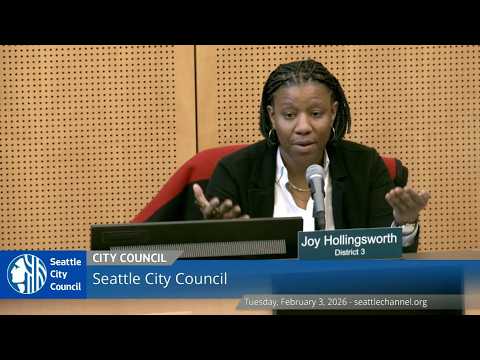
Dozens of public commenters at the Feb. 3 Seattle City Council meeting urged the council to remove ICE from city grounds, reject expanded surveillance and ensure a previously approved $4,000,000 reaches affected communities as direct services rather than surveillance. The council referred related legislation to the Public Safety Committee and noted oversight channels.
Dozens of speakers during public comment at the Feb. 3 Seattle City Council meeting urged the council to remove U.S. Immigration and Customs Enforcement (ICE) from city grounds, oppose expanded surveillance systems and ensure city funds flow to affected immigrants and refugees rather than to surveillance vendors.
Adriana Figueira, director of Community Without Borders, said she represents Venezuelan migrants and told the council, "I want you to know that I'm also afraid" while describing difficulty getting promised services and requesting a one-on-one meeting with staff to discuss legal aid and housing resources. Mirren Moreno described crossing the border with her family and said, "my daughter is being processed through a separate case from ours" and that her six-year-old had to appear in court alone, a fact Cassandra later emphasized as "disturbing." Cassandra, representing migrant-led groups, said organizers have long pressed for housing and legal services and urged the council to "kick ICE out of Seattle."
Several speakers criticized proposed or potential expansions of public cameras and data-sharing. Rose warned that "ICE is trying to use our phones to track our entire communities," and Liz Park, representing the International League of People's Struggle, cited a UW Center for Human Rights report alleging coordination between the Department of Licensing and ICE for surveillance, arguing that "more CCTV is not what's going to make our city safer." Bennett, who reviewed studies cited in the discussion, noted the research suggested surveillance reduces property crime but not violent crime and asked whether the city's intent is to deter property offenses.
Speakers also pressed the council about a $4,000,000 allocation Mayor Katie Wilson had promised for affected communities. Keandre asked how the city will ensure the funds are returned to the community and where the money will go; the clerk replied that the $4,000,000 stemmed from a council amendment passed last year and is directed to the Office of Immigrant and Refugee Services, which issues the request for proposals (RFP). Advocates said they want money and services directed to people directly impacted, not just to intermediary organizations.
The meeting record shows repeated calls for "services, not surveillance," and multiple speakers asked the council to prioritize immediate, tangible supports—legal aid, housing assistance and direct stipends—over increased camera networks. Several community organizations present said they would continue to push for legislation at the Public Safety Committee; the clerk noted Councilmember Rivera's related legislation will be considered at the committee's Feb. 10 meeting at 9:30 a.m.
The council did not make a substantive policy decision on surveillance or ICE during the meeting; public comment closed and the council moved to agenda business. The public record from Feb. 3 provides local officials and advocates a clear set of demands and points of evidence they can use going into committee hearings.