Get Full Government Meeting Transcripts, Videos, & Alerts Forever!
Get email alerts on the Transportation topic
No spam. Unsubscribe anytime.
San Mateo council keeps Humboldt bike lanes for now, orders lighting, parking and feasibility work
Summary
After hours of testimony on Humboldt Street, the San Mateo City Council directed staff to pursue street‑lighting upgrades, a targeted residential parking permit program, enforcement measures and a feasibility study (including a one‑way conversion option) while maintaining the existing bike lanes for the near term.
San Mateo — The City Council stopped short of removing the Humboldt Street protected bike lanes Tuesday, directing staff instead to pursue immediate safety and parking measures while studying longer-term changes.
Public Works engineer Jay Yu told the council the department’s analysis showed mixed community preferences across outreach formats and laid out five alternatives: keep the lanes, keep lanes with additional calming, move bike facilities to Idaho or Fremont as bike boulevards, remove lanes without a replacement, or invest in street‑lighting upgrades. Yu said staff’s objective was “to provide direction from city council on how to proceed with the Humboldt bike lanes alternative project.”
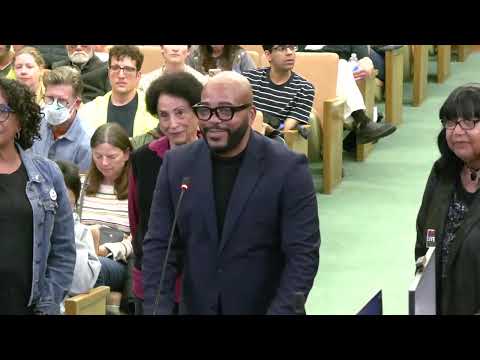
The meeting drew more than 80 organized and individual public speakers over nearly eight hours. Supporters of the existing lanes — including school staff and students, bike‑safety groups and many North Central residents — said Humboldt is a critical north–south corridor connecting schools and transit and that removing the lanes would endanger cyclists and students. Opponents, including neighborhood associations and many long‑time North Central residents, said losing more than 200 on‑street parking spaces has imposed daily hardships on seniors, large or multicar households and workers.
“Please vote yes to restore parking on North Humboldt Street,” said Mary Bevins of the Sunnybrae neighborhood, one of the organized presenters urging restored parking.
Speakers for Move San Mateo emphasized safety data and the corridor’s priority in the Bicycle Master Plan. “Our goal as a group is to push for prioritizing safety in street design,” Max Matner said during an organized presentation for Move San Mateo.
Council members said they were persuaded by both the urgency residents felt about parking and the safety concerns of bicyclists and parents. Councilmember Spierico Guditski proposed a more ambitious option to resolve the tradeoff: convert Humboldt to one‑way, which she said could restore on‑street parking while preserving space for protected bike lanes. “I’d like to propose a new alternative — that we convert Humboldt Street to a one‑way street,” she said during deliberations.
Council did not adopt a single design option. Instead the body coalesced around a two‑track approach: immediate and near‑term actions to reduce the neighborhood’s most acute problems, and a longer‑term feasibility study for a structural solution. The council’s directions to staff include:
- Move forward with street‑lighting upgrades and targeted traffic calming in the North Central corridor (staff to return with project scope and budgets). - Develop a Humboldt‑focused residential parking permit (RPP) program and return with outreach boundaries and an implementation timeline; council asked staff to explore narrowed boundaries (staff noted 1,000 feet as an initial suggestion to scope the analysis). - Increase targeted enforcement (abandoned vehicles, parking after hours, speeding) in the Humboldt corridor and report back on resources and costs. - Pursue a high‑level feasibility study — and, if warranted, a deeper engineering study — on converting Humboldt to one‑way to determine whether protected bike lanes and restored parking can be accommodated together; staff estimated a feasibility/planning program could take roughly a year and any full conversion could require multi‑million‑dollar investment.
Public Works presented cost estimates for alternatives: the staff analysis showed that removing the Humboldt bike lanes and building alternate bike boulevards with lighting would carry additional local costs and require replenishing the city’s local CDBG account because the bicycle components were originally funded with Community Development Block Grant (CDBG) dollars allocated through HUD. Jay Yu estimated that the bicycle‑improvement portion subject to repayment for the studied stretch would be about $273,000 and cautioned that removing that component would require local replenishment.
City Manager Kajikian and staff said they would return with recommended budget appropriations and timelines for the work the council directed. Staff cautioned that a feasibility study for a one‑way configuration would be large in scope — involving circulation modeling, traffic mitigations and community outreach — and would require consultant procurement and possible grant searches to lessen local general‑fund impacts.
Mayor Adam Lorraine said he supported the mixed approach: “Returning parking to the way it was is not the answer,” he said, urging targeted mitigation and a holistic long‑term plan that avoids “throwing good money after bad.”
Next steps: staff will prepare scopes and budget requests for the lighting and enforcement work, return with an outreach plan and proposed boundaries for a Humboldt‑area residential parking permit program, and develop the approach and cost estimate for a one‑way feasibility analysis. The council did not take an immediate binding vote to remove or restore the bike lanes.