Get Full Government Meeting Transcripts, Videos, & Alerts Forever!
Get email alerts on the Tenant Protection Act topic
No spam. Unsubscribe anytime.
Davis presentation outlines landlord responsibilities under California's Tenant Protection Act
Summary
At a City of Davis rental-resources session, presenter Chad explained how the California Tenant Protection Act alters notice requirements, sets a rent-increase cap (5% plus CPI, capped at 10%), creates just-cause rules after residency triggers, and described the unlawful detainer process and local practices in Yolo County.
Chad, the session presenter, told Davis landlords and property managers that the California Tenant Protection Act, enacted in 2019, remains in force and imposes two core obligations: landlords subject to the law must (1) state a legally sufficient reason ("just cause") to terminate or refuse to renew a tenancy once residency triggers are met and (2) respect a statewide cap on annual rent increases.
Why it matters: the law changes how many routine landlord actions must be documented and timed. Chad emphasized that failing to deliver the statute's required notices can convert an otherwise-exempt property into one treated as subject to the Act for enforcement or court purposes, and that tenants can use such failures as a defense in eviction proceedings.
Key points from the presentation
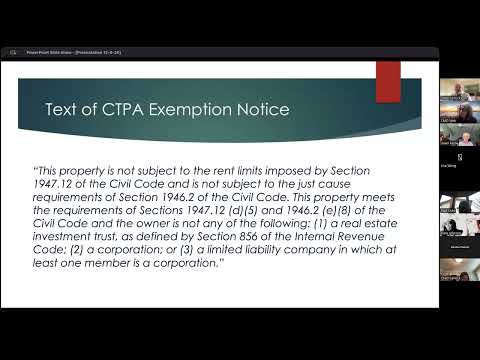
- Notice and exemptions: Landlords must provide tenants with either the Act's required notice of tenant rights if the property is covered or a written notice of exemption when the property is statutorily exempt (for example, qualifying single-family homes, owner-occupied duplex rentals and properties built within the last 15 years). Chad warned that if a landlord claims an exemption but did not serve the written notice, courts "are probably going to look at that as if the act applies." He recommended adding the notice as a lease addendum or having tenants sign a receipt.
- Just-cause triggers and types: The Act's just-cause protections take effect after tenants have occupied a unit for the statutory trigger period: at least 12 continuous months for all tenants or 24 months if at least one tenant has been there continuously. Chad described two categories of just cause: "at fault" (nonpayment, lease breaches, nuisance, criminal activity) and "no fault" (owner move-in, removal from the rental market, demolition or substantial remodel). For no-fault terminations, landlords must provide relocation assistance equivalent to one month's rent, either as a cash payment or a credit.
- Rent-cap formula: Under the Act, allowable annual increases equal 5% plus the Consumer Price Index (CPI) for the applicable region or statewide CPI, but never exceed 10% in a 12-month period. Chad used the 2025 statewide CPI (3.3%) as an example, which would produce an 8.3% cap for that year. He advised landlords to check official CPI sources regularly because the numbers are updated periodically.
- Eviction (unlawful detainer) process and timelines: Chad walked through the steps a landlord should take before filing (verify applicability of the Act, confirm notices were served and keep proof of service). After filing an unlawful detainer, the tenant has 10 court/business days to respond; if no response is filed, a landlord can seek a default judgment and a writ of possession. If the tenant responds, a trial must be requested; Chad said California aims for trial settings within 20 days of the request. He noted local practice in Yolo County where UD trials are typically scheduled on Friday afternoons at 1:30 p.m. in Department 2 in Woodland and that the court often offers an optional neutral mediator before trial.
- Enforcement and damages: Failure to provide required notices can lead to dismissal of an eviction action, local enforcement actions (Chad cited the City of Davis rental registry as an enforcement avenue), and potential damages; in cases of willful violations a tenant may seek up to three times their out-of-pocket costs.
Q&A highlights and resources: During the Q&A attendees asked (among other topics) whether a professionally managed single-family rental loses its exemption (Chad said it does not if the owner otherwise qualifies), where to find archived materials (cityofdavis.org rental resources page; Patty posted a link in chat), and typical eviction costs (filing fees of a few hundred dollars and attorney costs that can amount to several hours'work'potentially putting the total in the low thousands). Chad said slides and the recorded presentation would be posted on the City of Davis website and shared his contact details and carlocklaw.com for further questions.
Next steps: Chad announced the fourth presentation in the series, scheduled for March 10, 2026, covering property managers' and owners' responsibilities during a tenancy.
Ending note: The session emphasized documentation: serve and keep written notices (either the Act's tenant-rights notice or a notice of exemption), confirm service method and proof, check CPI numbers before applying rent increases, and be prepared for the time and expense of an unlawful detainer if a tenant fails to vacate.