Get Full Government Meeting Transcripts, Videos, & Alerts Forever!
Get email alerts on the Education Budget Contracts topic
No spam. Unsubscribe anytime.
Legislative analysts recommend ending some contracted education grants, including competency-based program
Summary
Legislative staff recommended discontinuing Utah’s Competency-Based Education Grants ($2.09M ongoing) and trimming an innovation-in-civics pilot ($87,400 one-time), saying other online and local options now meet the program’s original goals; the Utah State Board of Education largely agreed but cautioned about FTE impacts.
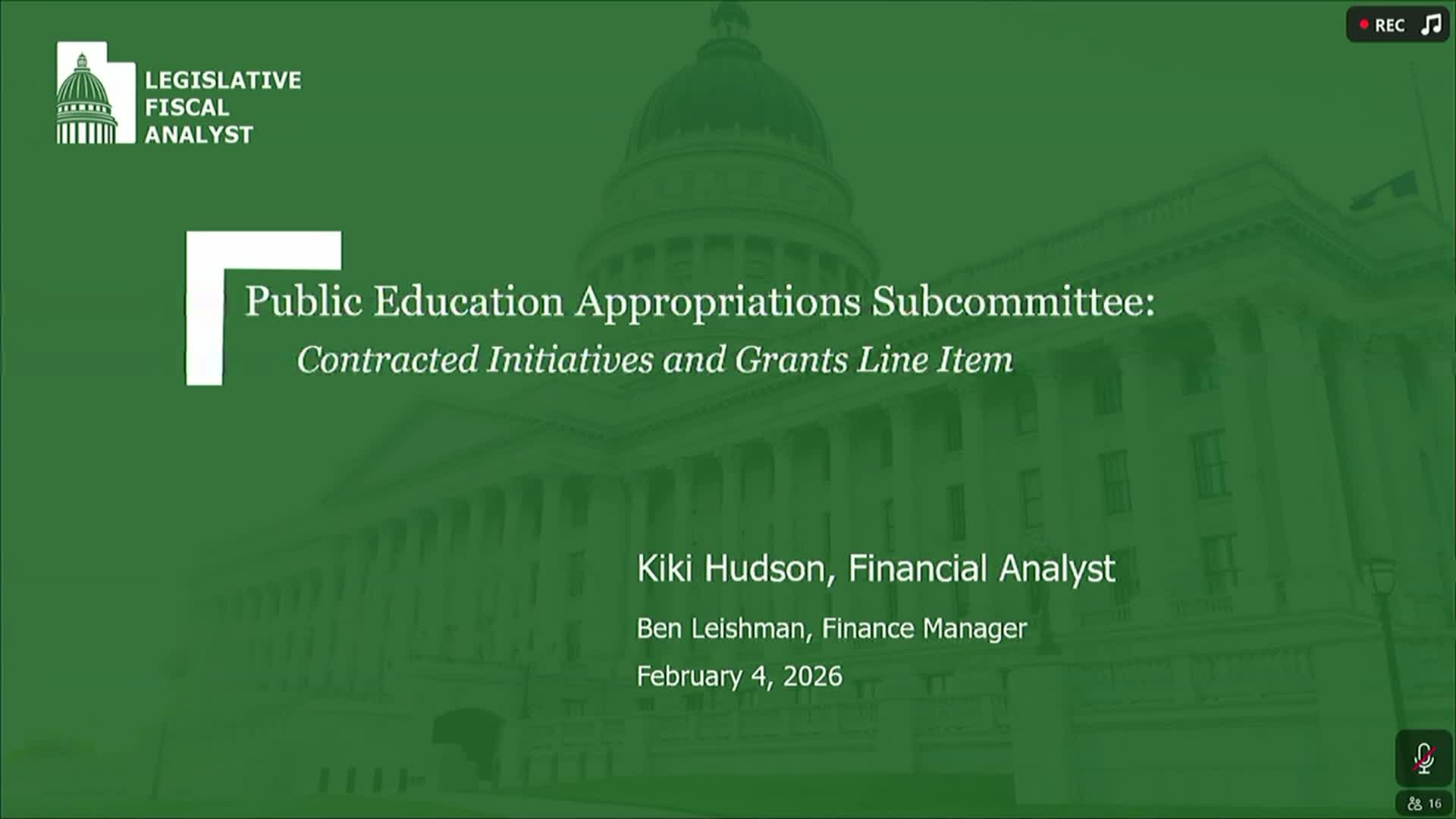
Legislative staff outlined proposed cuts to the Contracted Initiatives and Grants line item during the Public Education Appropriations Committee meeting, recommending elimination of the Competency‑Based Education Grants and a modest one‑time reduction to an innovation in civics education pilot.
Kiki Hudson, who presented the Legislative Fiscal Analyst overview, told the committee the line item supports 22 active programs and has a FY27 funding base of about $40.3 million. Hudson said the Competency‑Based Education Grants, enacted in 2020 to support personalized and blended learning, faces ongoing reduction of $2,093,100 because many of its original objectives are now available through other online or supplemental options and because local education agencies (LEAs) sometimes take years to administer and be reimbursed for grants.
“The program was designed to support personalized, blended and extended learning opportunities,” Hudson said. “Under a strained budgetary environment this year, this program was not recognized as essential instruction for students.” She said LEAs would still have the option to provide similar competency‑based initiatives at the local level.
Hudson also recommended a $87,400 one‑time reduction to the innovation in civics education pilot, explaining the program met its performance targets and concluded with a remaining balance after a three‑year appropriation that began in 2022.
Utah State Board of Education chair Matt Hymas, and deputy superintendent Scott Jones, joined the committee to respond. Hymas said the board’s recommendations generally align with the LFA’s and noted the board had proposed phased reductions (plan 1 and plan 2) so the committee could consider timing and operational impacts. He urged the committee to consider that eliminating programs can also result in the loss of a board position or FTE.
“Eliminating the program would also include one FTE or a one position at the Utah State Board of Education,” Hymas said, urging the committee to weigh personnel impacts in addition to programmatic outcomes.
Committee members asked whether the civics pilot cut represented unused balances; Hudson answered that the recommended reduction reflected remaining non‑lapsing balances. Members also pressed for more detail about how competency‑based program goals are now addressed through other options; Hudson cited alternative online offerings and district programs as substitutes.
The committee did not take a final vote on the line‑item recommendations in the presentation. The discussion will inform budget negotiations as the committee balances statewide priorities and the financial tradeoffs of maintaining targeted grant programs.