
Local coalition survey warns federal grant shifts have put nonprofits’ services and staff at risk
Get AI-powered insights, summaries, and transcripts
Subscribe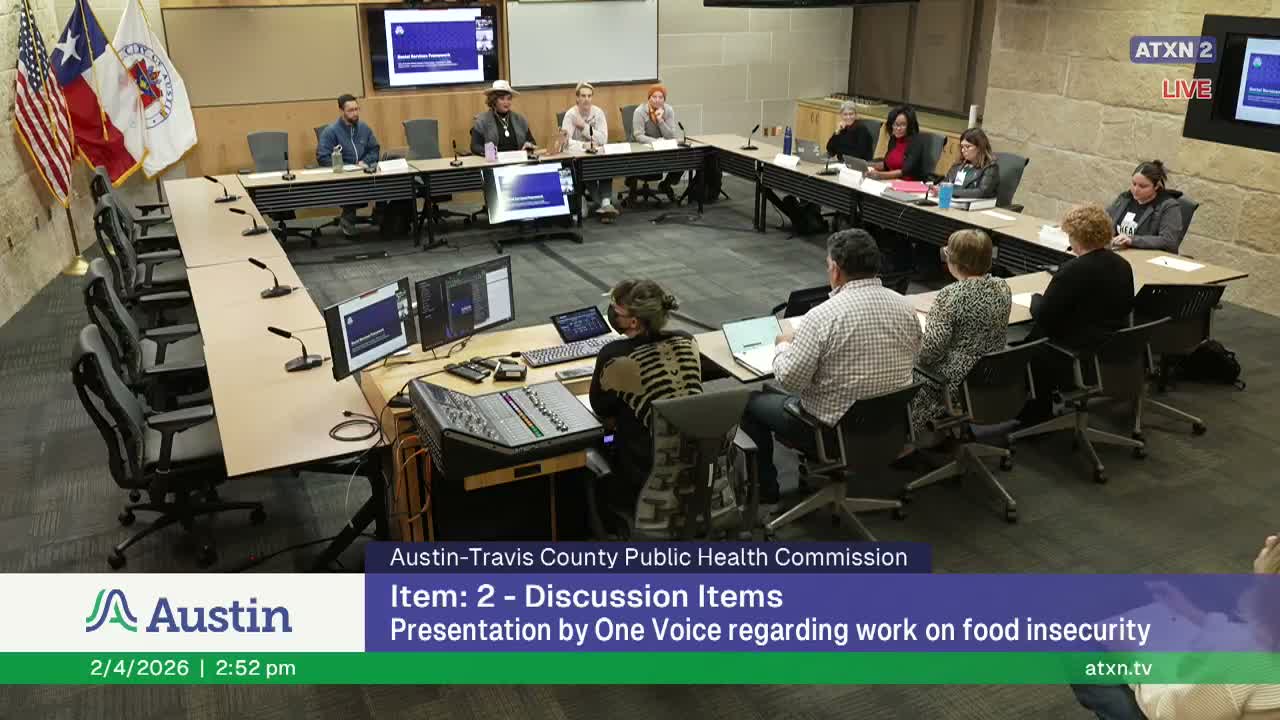
Summary
A cross-sector coalition presented preliminary survey results indicating federal grant changes have created immediate funding losses for Central Texas nonprofits, reporting nearly $18 million in documented losses in the cleaned sample and widespread service, staffing, and capacity impacts; presenters emphasized the data are exploratory and likely underreported.
A coalition of Central Texas nonprofits and funders told the Austin-Travis County Public Health Commission that preliminary survey results point to major instability for health and human service providers after recent federal funding changes.
Lynn Skinner, executive director of Social Venture Partners in Austin, described the report as “very preliminary” and said the coalition fielded a membership survey that, after deduplication and cleaning, yielded about 82 usable responses. The cleaned dataset presented roughly $18 million in immediate federal funding losses among respondents and another $23 million reported as frozen or uncertain as of Oct. 1, a sum the presenters described as nearly $42 million at risk in the sample."These are not insubstantial amounts of money,” Skinner said.
Peter Arellano, a senior planner with Travis County Health and Human Services who performed the data cleaning and analysis, cautioned that the findings likely understate the full picture. "I think the biggest takeaway that I wanted to convey is ... like I think all of our numbers are underreported," he said, noting variable response rates across survey items and a lower completion rate for the survey sections with the most detailed financial questions.
The presenters said respondent profiles included about 6,400 employees across the 82 organizations, that roughly 21% of those organizations’ activity in the sample was supported by federal funds, and that 68% of respondents reported receiving federal funding either directly or indirectly. Respondents reported operational impacts already underway: the coalition said 70 layoffs had been reported across the surveyed organizations with 40 additional layoffs expected in the coming months, and many organizations said they were preparing program reductions, client reductions or staff reductions if funding did not stabilize.
Commissioners asked for more granular data (such as ZIP-code-level information) and for the coalition to convene funders, nonprofits, and municipal partners to coordinate responses. Several commissioners suggested pairing affected service lines (for example, mental-health and behavioral-health programs) with large local funders and health systems such as Central Health or Baylor Scott & White to shore up essential services.
The presenters and County staff emphasized limits to the dataset and the exploratory nature of the analysis and said they would continue analysis of qualitative responses, expand outreach, and return with more detailed findings and stories to inform advocacy and funding conversations. The coalition also called on local philanthropists and funders to hear the human stories behind the numbers to guide immediate and longer‑term responses.