
ACME funding update: 2,455 eligibility forms reviewed; Austin Live Music Fund to distribute $7 million across ~380 awards
Get AI-powered insights, summaries, and transcripts
Subscribe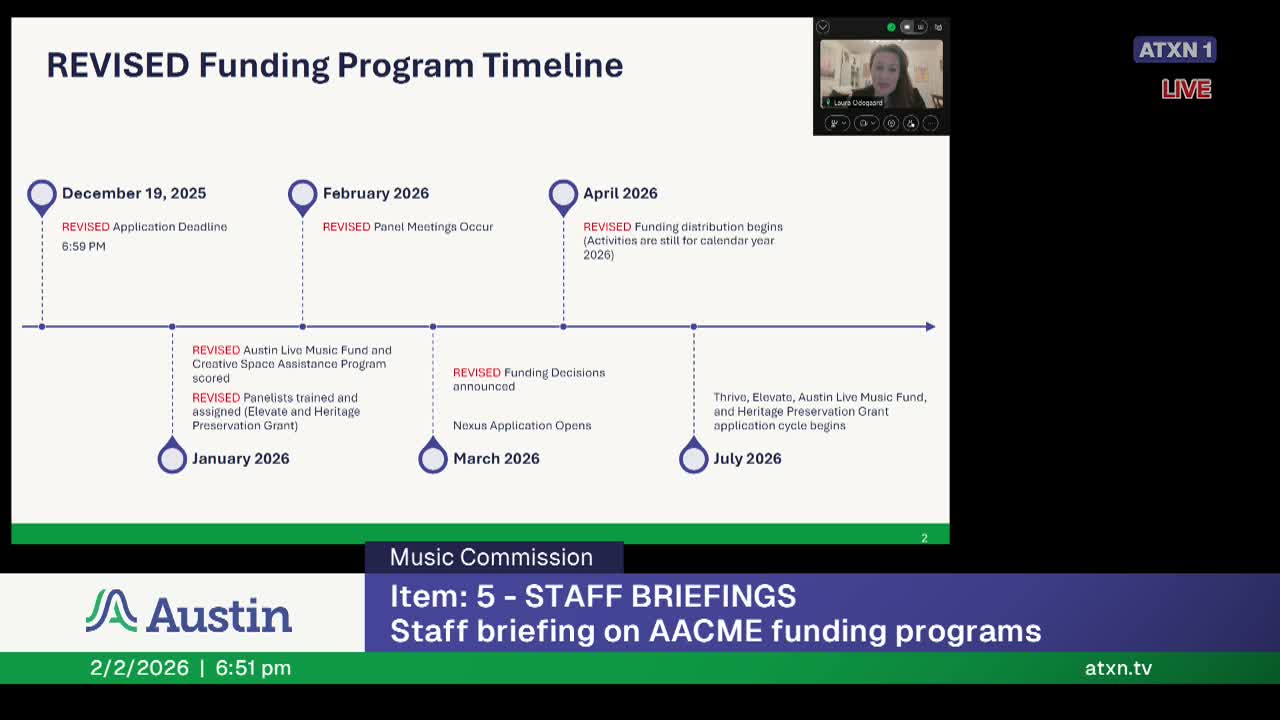
Summary
ACME staff reported they processed 2,455 eligibility forms and expect roughly 380 awards from the $7 million Austin Live Music Fund; staff cited insufficient evidence as the largest reason for ineligibility and said award announcements will be made in March with first payments in April.
Laura Odegard, acting division manager for Austin Arts, Culture, Music, and Entertainment (ACME), told the Music Commission that staff have reviewed 2,455 eligibility forms across ACME programs and are in the scoring and evaluation phase.
Odegard said the Austin Live Music Fund totals $7,000,000 and staff currently expect about 380 awards overall. "For the music venue category, we anticipate around 22 awards; for the larger $20,000 award level we anticipate roughly 242 awards; and for the $5,000 level we anticipate about 120 awards," she said. She emphasized those figures are preliminary and will be finalized after scoring.
Odegard said staff manually reviewed eligibility forms and that 122 Austin Live Music Fund eligibility submissions were judged ineligible (120 English, 2 Spanish). The most common reason for ineligibility was "insufficient evidence" that applicants met the program definitions for professional musician, live-music venue, or independent promoter; other reasons included applicants under age 18 or City of Austin employees.
"We sent a bilingual survey to more than 2,000 applicants and already have about 120 completed responses," Odegard said, noting staff plans to use that feedback and follow-up focus groups to improve guidance before the next application cycle in July. She added ACME and Long Center staff will prepare a final outcomes report for commissioners and said staff hope to produce outreach materials (including a short promotional reel and case studies) describing successful award outcomes.
Odegard also summarized the review process: this month ACME is running 36 panel meetings to review roughly 726 applicants, with more than 200 panelists trained to evaluate applications. She said award announcements across ACME programs are scheduled for March and the first disbursements will begin in April.
Commissioners raised concerns about why more applicants applied for the $20,000 awards than the $5,000 awards. Commissioner England asked whether applicants were "shooting for the biggest award" rather than choosing the simpler $5,000 application. Odegard and Erica Shamali (Music & Entertainment Division Manager) said the two award levels use separate application tracks by design: the smaller award uses a simpler application to reduce burden, while the $20,000 application contains additional "accomplishments" questions recommended previously by the Music Commission to prioritize applicants with more established careers.
Staff said they will analyze score distributions, consider whether to shift award-bucket allocations, and explore operational changes (for example, whether applicants who do not qualify for $20,000 could automatically be considered for $5,000) before the July cycle.
The presentation included marketing and outreach results: paid and earned media placements produced about 1,120,000 impressions, a roughly 20% increase in web traffic attributable to paid social ads, a 2% banner-ad click-through rate, and more than 10,000 mobile views, metrics Odegard said indicate broad awareness of the programs.
Odegard asked commissioners to provide feedback; she said she will send a tweaked version of the applicant survey to commissioners so they can provide input. The department also plans internal retrospectives and partner-led focus groups to better support future applicants.
Next steps: Odegard said award announcements are expected in March, contracts and first payments in April, and staff will return to the commission with additional reports on scoring outcomes and any recommended process changes.