
Parks board declines authorization for mobile camera trailer contract after privacy and cost concerns
Get AI-powered insights, summaries, and transcripts
Sign Up Free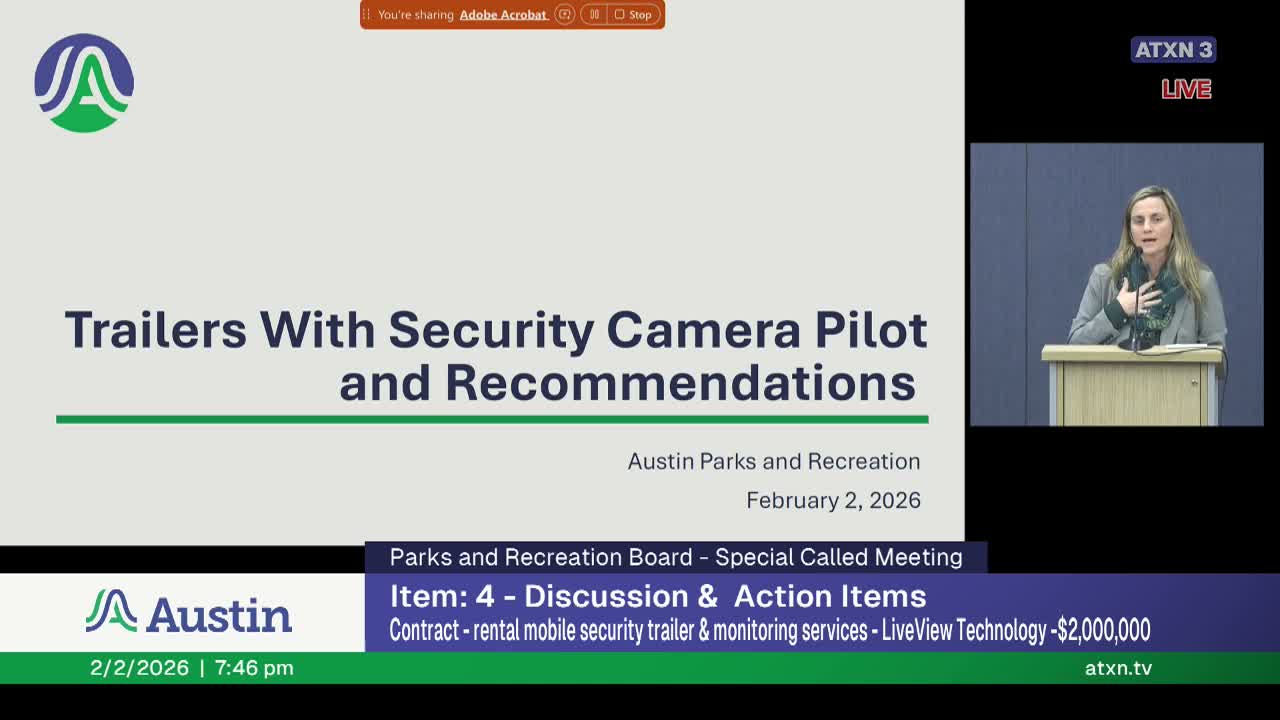
Summary
After a multi‑hour discussion, the Parks and Recreation Board voted down a motion to authorize negotiation of a contract for mobile camera trailers and monitoring services, citing unresolved privacy, vendor vetting, and budget questions despite staff citing pilot results that showed reductions in reported burglary of vehicles at certain hotspots.
The Parks and Recreation Board considered staff’s recommendation to authorize negotiation and execution of a contract for mobile camera trailers and monitoring services but voted to reject the motion after extended public comment and board discussion.
APR staff presented a three‑year contract with two one‑year extensions (up to five years) and an overall authority of up to $2,000,000 for the contract life. Staff described a pilot that placed mobile camera trailers at park hotspot locations beginning May 31, 2023; APR said some sites saw reductions in reported burglary of vehicles and that footage is stored in a CJIS‑compatible, U.S.‑based cloud with a 60‑day automatic deletion policy. Staff also said the contract includes prohibitions on facial recognition and biometric identification.
Public commenters and several board members raised data security and vendor‑vetting concerns, noting that LiveView Technologies (a vendor referenced by commenters) has third‑party partnerships and that some surveillance analytics companies have controversial development histories. Speakers also questioned whether the cameras were an effective deterrent statewide and whether APD actually uses footage to prosecute property crimes.
Board members asked for clarifications on monitoring procedures (footage is not continuously monitored and is accessed by authorized city personnel upon request), who can access footage, whether federal requests might apply, signage for recorded areas, and cost implications for the city’s constrained budget. Staff said the department has $254,000 in operating security funds and expects to spend between $150,000 and $200,000 a year under a typical deployment of 6–10 trailers.
The motion to authorize negotiation (moved by Board Member Becker and seconded by Board Member Franklin) failed; votes in favor were limited and multiple members voted against or abstained. Staff said they will continue to work with legal and technology teams and that the item will go to City Council for related policy guidance on surveillance.
Board members asked APR to report back with vendor vetting details, contract safeguards, access controls, evidence of law enforcement use of footage, multilingual signage requirements, and clearer budget implications.