Get Full Government Meeting Transcripts, Videos, & Alerts Forever!
Get email alerts on the Budget And Finance topic
No spam. Unsubscribe anytime.
SFPUC adopts amended FY2025–26 budget, 10‑year CIP and financial plan; forecasts years of rate increases
Summary
The San Francisco Public Utilities Commission voted to amend the FY2025–26 operating budget, seek Board of Supervisors approval for $1.054 billion in water revenue bonds, adopt an $11.06 billion 10‑year capital improvement plan and approve a 10‑year financial plan that projects multi‑year rate increases for customers.
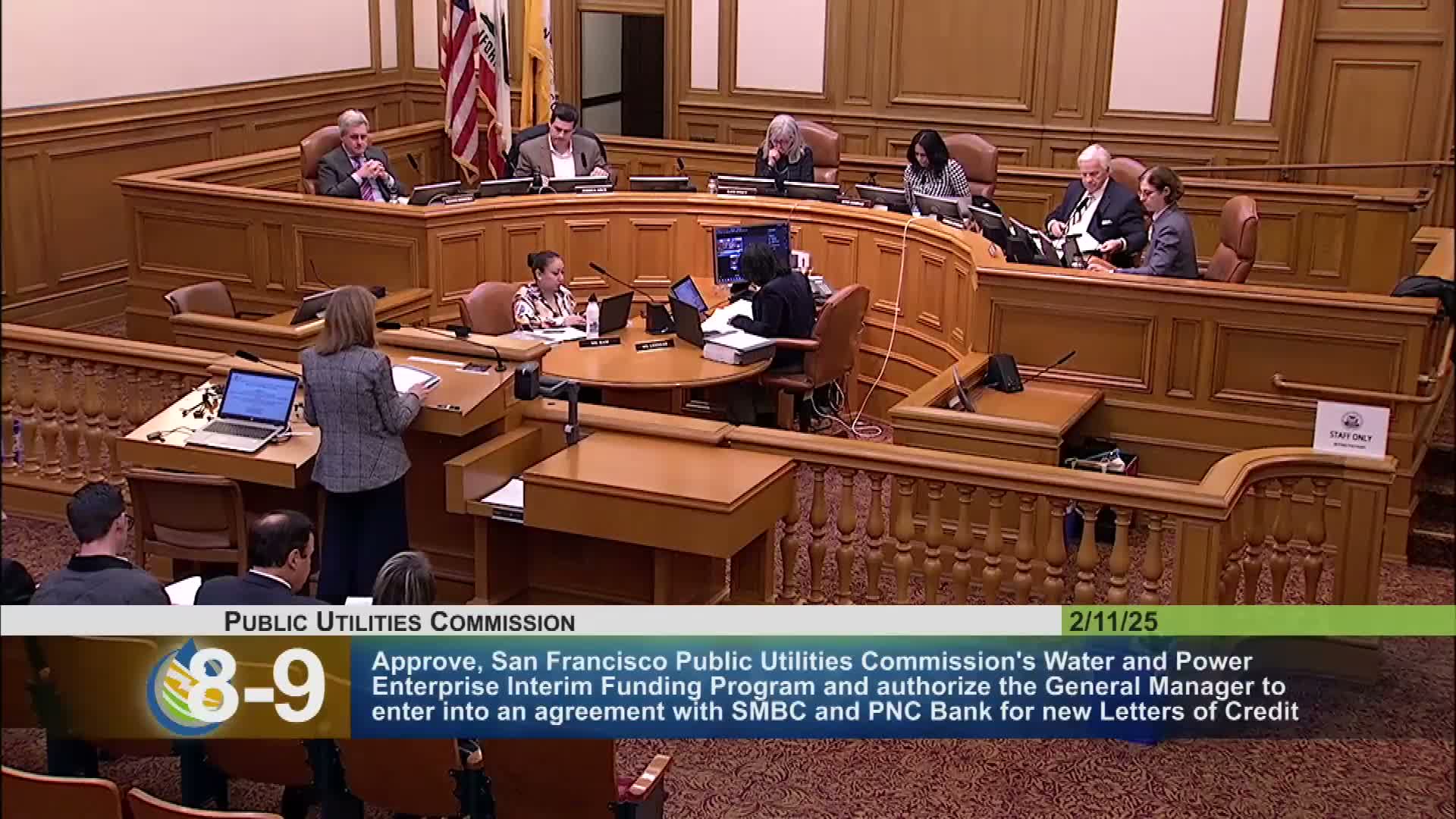
The San Francisco Public Utilities Commission on Wednesday adopted amendments to its FY2025–26 operating budget, authorized staff to seek Board of Supervisors approval for $1,054,138,857 in water revenue bonds, approved an $11,062,520,691 10‑year capital improvement plan and adopted a 10‑year financial plan that staff said will require higher rates in coming years.
Commissioners heard presentations from Laura Bush, deputy chief financial officer, Trey Hunter, acting capital budget manager, and Erin Corvinova, financial planning director, who said the updated plan uses conservative assumptions — including a 6% assumed interest rate on future debt and lower sales forecasts — to strengthen financial metrics and protect the utility’s bond ratings. Corvinova told the commission staff increased the share of the CIP paid with current revenue to about 29% to reduce long‑term reliance on debt while acknowledging that the change contributes to near‑term rate pressure.
The financial plan projects compound annual increases of about 6% for water rates and about 10.5% for wastewater rates over the 10‑year planning horizon. Combined and adjusted for expected lower usage, staff presented a forecast of an average single‑family customer’s combined water and wastewater bill rising about 8.6% annually over the 10‑year period. Staff emphasized that only the next fiscal year’s rates are approved now; the remainder are forecasts and must return to the commission for future approval.
Commission discussion focused on affordability and trade‑offs. Commissioners pressed staff about tools to constrain future rate growth, including prioritizing and deferring capital projects, aggressively pursuing low‑cost state and federal loans, and shifting more capital to cash funding in some cases to reduce long‑term interest costs. Staff said regulatory requirements and aging infrastructure constrain some options; they flagged nutrient‑reduction obligations and other state mandates as drivers of increased capital need.
Public comment included callers who commended the staff’s transparency while urging earlier public engagement in the budget process and deeper analysis of demand and alternative water supply assumptions.
The commission then voted separately on the items: a motion to approve the FY2025–26 operating budget amendment passed by roll call with the commissioners recorded as voting Aye; the authorization for the general manager to seek Board of Supervisors approval for the stated water revenue bonds passed; the 10‑year capital improvement plan and the 10‑year financial plan were both adopted in separate roll call votes. The commission directed staff to return with further detail on bond timing and on options for prioritizing projects during the next capital planning cycle.
The adoption completes the commission’s mid‑cycle actions and sends the amended budget and the debt authorization request to the mayor and Board of Supervisors for their subsequent review and approval.