Get Full Government Meeting Transcripts, Videos, & Alerts Forever!
Get email alerts on the Construction Coordination topic
No spam. Unsubscribe anytime.
Board authorizes ATP to join Central Texas Construction Partnership; TxDOT presents CTX GO app
Summary
The Austin Transit Partnership board unanimously authorized an interlocal agreement to participate in the Central Texas Construction Partnership Program after a TxDOT presentation on CTX GO, a coordinated real‑time construction and traffic information app. TxDOT cited an initial contribution of about $4.1 million and a phased roll‑out with full implementation by 2027.
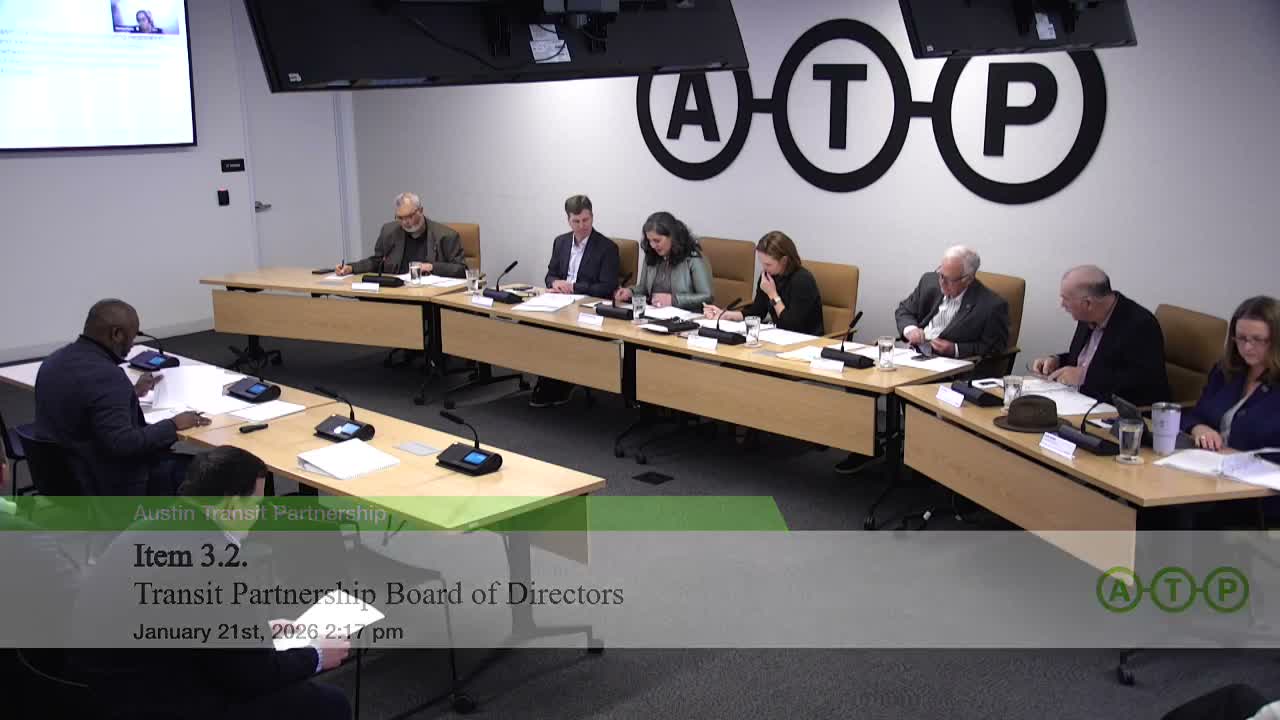
The Austin Transit Partnership board on Jan. 21 voted to authorize an interlocal agreement to join the Central Texas Construction Partnership Program, a coordination effort to centralize construction and traffic information across agencies.
Tucker Ferguson, district engineer for TxDOT’s Austin District, described CTX GO, an app designed to aggregate real‑time construction and traffic data from multiple agencies and provide routing guidance that can link with navigation services. Ferguson said the program is in its infancy but already drawing national attention; he said TxDOT’s contribution to the partnership is about $4,100,000 and full program implementation is expected by 2027. “We brought this together with all of our partners so we can input it to be a one‑stop shop for folks to go to and really get real time information,” he said.
Board members asked whether the app will include bicycle‑ and sidewalk‑closure data and urged coordination with school districts and other jurisdictions. TxDOT representatives said the system relies on project teams to enter closure and schedule information and that some closures for bridge work may require temporary shutdowns during off‑peak hours.
The board voted to authorize the interlocal agreement (action item 3) unanimously. In discussion the board confirmed that participant contributions are proportional to program size and activity and that an initial fee structure includes a line item cited in the meeting as $411,150 for the first two years; staff said funding beyond the pilot period would return to the board for approval.