Get Full Government Meeting Transcripts, Videos, & Alerts Forever!
Get email alerts on the Franchise Leak Detection topic
No spam. Unsubscribe anytime.
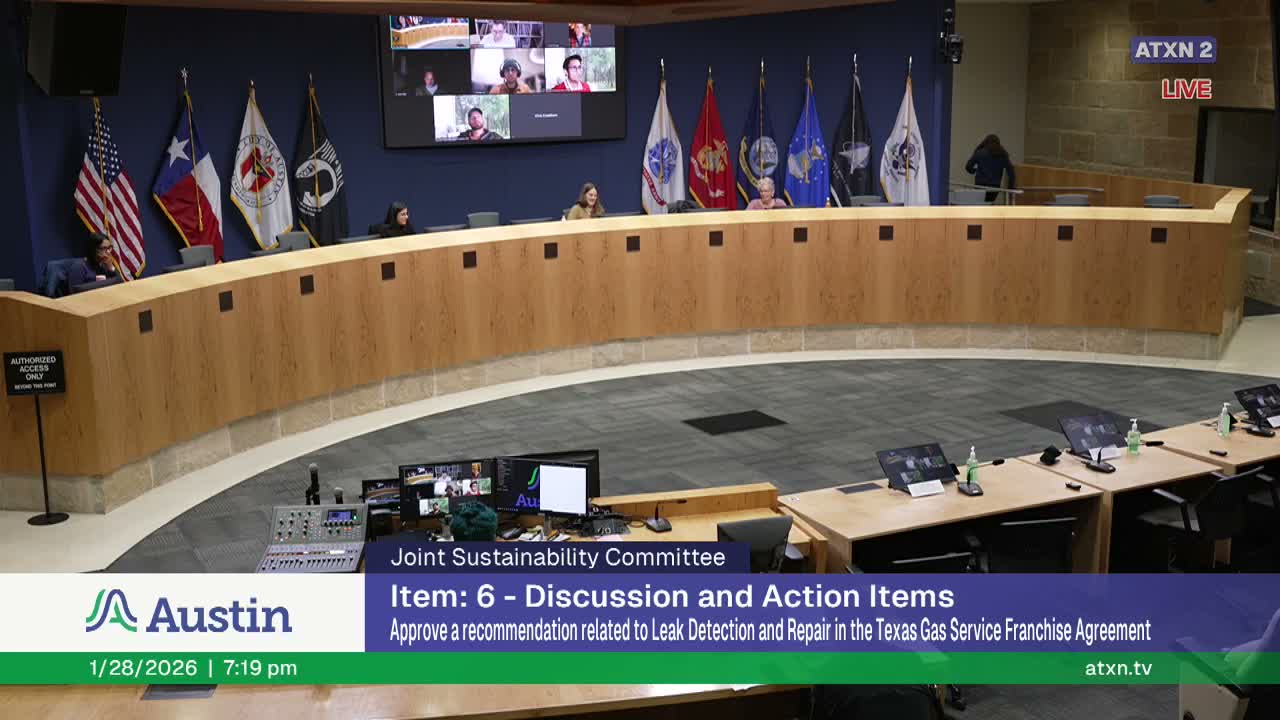
Austin sustainability panel unanimously backs stronger methane leak-detection, reporting language for gas franchise
Summary
The Joint Sustainability Commission voted to recommend that Texas Gas Service adopt industry-leading leak detection and repair technologies, report LDAR performance for the Austin Metropolitan Area, and pursue third‑party validation to reduce self-reporting conflicts of interest.
The Joint Sustainability Commission on an otherwise routine meeting unanimously adopted a recommendation asking City Council negotiators to press Texas Gas Service to strengthen methane leak detection and repair requirements in the companyfranchise agreement.
The committeefs recommendation calls on the gas utility to "employ industry leading advanced leak detection repair technologies, and improve those as technology advances," expand its leak search footprint, reduce emergency response times and submit annual reports on LDAR (leak detection and repair) performance, the presenter said. The recommendation was amended to specify reporting for the "Austin Metropolitan Area," add an acknowledgement that "self reporting on leak detection could create a potential conflict of interest," and to "recommend further study of options, including third party validation," and to require reporting the number of leaks repaired and any patterns suggesting broader system remediation.
"The company should be required to employ industry leading advanced leak detection repair technologies," the presenter said while describing the RMCfs voted package. Aaron Gonzales warned that relying solely on company-submitted reports could present a conflict: "self reporting on leaks, leak detection and repair in an annual report ... could create a conflict of interest," he said, and urged study of mitigation options.
Commissioners reported that the Resource Management Commission had unanimously approved a similar package and that a Texas Gas representative at that meeting indicated openness to many of the ideas. The presenter said the current franchise, last updated in 2006, offers a rare opportunity to codify improved practices in the city's license for right-of-way access.
After members offered a friendly amendment to expand the reporting geography to the Austin Metropolitan Area and add third‑party validation language, the committee voted to adopt the amended recommendation. The chair said the group will forward the amended language to staff to include in the City Council negotiation record.
The commission also discussed related items in the RMC package, including proposals to return conservation-program management to the city and to study capital-recovery fees to ensure large new customers pay their fair share; those recommendations were described as potential additional inputs to the franchise negotiation.
Next steps: The commission will transmit the amended recommendation to City Council staff and follow up as the franchise renewal process proceeds; the presenter said the franchise term renewal timeline makes early input important.