Senate Judicial Proceedings Committee hears broad slate of bills on pets, courts, housing, consumer protections and survivors’ rights
Loading...
Summary
On Feb. 3 the Senate Judicial Proceedings Committee heard testimony on more than a dozen bills, from allowing donation of unused pet food and adding a Queen Anne’s County judge to proposals on public‑road status, condo insurance deductibles, open‑caption movies, limits on child‑support collections for foster‑care parents, protections against "zombie" foreclosures, a new procedure for proving medical bills in court, codifying disparate‑impact housing claims, restoring jury eligibility to many people with prior convictions, and shielding good‑faith reporting by sexual‑assault survivors.
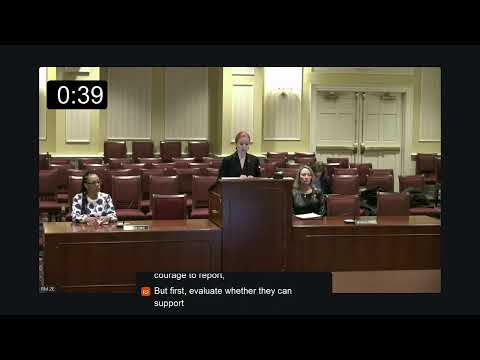
Annapolis — The Senate Judicial Proceedings Committee convened Feb. 3 for a wide-ranging slate of hearings on bills that would affect courts, consumer protections, housing policy and civil‑justice procedures across Maryland.
The session opened with a procedural reading of the day’s agenda, then moved through multiple bills that drew supporters and opponents to testify in person and virtually.
A pet‑food donation bill: Senator Nick Charles opened the first hearing, SB 3-14, proposing to extend the legal framework that protects donations of human food to cover pet food. Stacy Velodin, Maryland state director for Humane World for Animals, told the committee shelters face rising costs and empty pet‑pantry shelves and that “the only thing standing in the way of this surplus… is the fear of liability,” urging a favorable report. Retail worker Sally Tom offered a retail vantage, estimating heavy daily waste at stores and calculating that, on a national scale, “50 pounds per day times 365 days a year times 3,000 stores nationwide is 54,750,000 pounds of kibble,” and argued liability protections would let retailers donate usable product instead of discarding it.
Courts and judgeships: Senator Steve Hershey presented SB 3-58, a local bill to add a second resident circuit court judge in Queen Anne’s County. Judge Lynn Knight and county officials said the county built a two‑courtroom courthouse to accommodate a second judge, and that growing caseloads — and local willingness to cover county‑level costs — justify a new judgeship. The Administrative Office of the Courts has signaled reluctance pending work on a statewide model, a point that prompted extended questioning about timing, local conditions and statewide allocation processes.
Roads and homeowner protections: SB 2-58 (sponsored by Senator Attar, read into the record by staff) responded to Baltimore City residents who say streets maintained by the city for decades are suddenly being reclassified as private and deprived of city services. Sandy Rosenbluth and neighborhood witnesses described reliance interests stemming from long‑term public maintenance; proponents asked the committee to codify the common‑law standard (long, uninterrupted public use and public maintenance) so homeowners do not lose services without notice.
Condominium insurance deductibles: Ben Kramer’s SB 3-32 would raise the statutory maximum for a unit owner’s share of a condominium association’s property‑insurance deductible from $10,000 to $25,000. Proponents, including insurance professionals, said insurer market practice has already pushed deductible levels higher and that matching unit‑owner responsibility to the master policy will reduce special assessments; condo owners and tenant advocates warned the change could increase costs for low‑income or fixed‑income residents and urged careful tailoring and consumer protections. Sponsors said amendments would clarify when associations may elect not to file claims and would require owners to carry HO‑6 coverage sufficient to cover assessment risk.
Accessibility for moviegoers who are deaf or hard of hearing: SB 2-59 would lower the threshold for cinemas required to provide open‑caption screenings from eight to four screens, expanding open‑caption availability in rural and underserved regions, supporters said. Disability advocates and deaf‑community organizations testified that open captioning avoids dependence on separate devices that can malfunction or be unavailable.
Child‑support policy while children are in foster care: SB 3-19 would restrict the state’s practice of placing child‑support orders against parents whose children are in foster care, except in narrowly defined circumstances. Sponsors and the Office of the Public Defender argued the measure limits punitive collections that compound poverty and prolong families’ involvement with the child‑welfare system; several witnesses asked for clarifying language to guide Department of Human Services discretion and to combine proceedings for efficiency.
“Zombie mortgage” protections: SB 3-53, aimed at preventing very old delinquent mortgage claims from reviving years later, would set a limitations period (sponsors discussed 10 years and were open to 12) and require debt buyers enforcing loans over five years old to document chain‑of‑title and ownership. Consumer advocates and the Office of Financial Regulation described cases where decades‑old liens and accumulated fees produced crushing payoff demands for homeowners; banking and title‑industry witnesses cautioned about unintended credit market impacts and constitutional concerns if new limits were applied retroactively.
How medical bills are proven in court: SB 2-69 would create a rebuttable presumption that medical bills admitted into evidence are authentic and reasonable, reducing the routine need for plaintiffs to call billing experts in every case. Plaintiffs’ counsel and trial‑lawyer groups said the presumption would streamline proceedings where fairness of the bill is not in dispute; insurers and employer/defense groups warned the statutory presumption could privilege charge‑master sticker prices that bear little relation to amounts actually paid under contracts with insurers, shifting litigation costs to defendants and insurers. Witnesses debated whether the bill would change awards or only reduce repetitive expert testimony; the proponents stressed the defendant retains the right to rebut when reasonableness is genuinely at issue.
Housing‑segregation and disparate‑impact law: SB 2-74 would explicitly codify disparate‑impact liability and authorize the Department of Housing and Community Development to issue regulations to affirmatively further fair housing. Civil‑rights organizations, legal aid and tenant advocates framed the bill as restoring state protections and regulatory tools as federal guidance changes; housing providers and insurers asked for technical amendments to avoid unintended interaction with insurance underwriting rules and to clarify intent and scope.
Jury eligibility and re‑enfranchisement: SB 3-22 would narrow Maryland’s broad exclusion from jury service for people with certain prior convictions, permitting many people who have completed sentences to serve unless convicted of offenses that directly undermine courtroom integrity (perjury, jury intimidation, certain frauds). Supporters argued the change would diversify juries and improve deliberation; opponents stressed voir dire and existing protections and sought precision about which fraud‑related convictions should remain disqualifying.
Protecting survivors from retaliatory suits: SB 2-95 (Stop Silencing Survivors Act) would provide a statutory safe harbor for people who, acting in good faith, disclose allegations of sexual assault, while preserving relief where a plaintiff proves disclosure was made with actual malice or recklessly false. Survivor‑advocacy groups and campus legal clinics argued the bill would reduce retaliatory civil suits that deter reporting; sponsors said the standard was adjusted in committee to require proof by a preponderance of the evidence to overcome the good‑faith presumption.
What’s next: Most bills were left for further committee work, amendments and follow‑up with affected stakeholders. Several sponsors said they expected technical amendments (insurance‑market language for SB 3‑32, mapping and maintenance clarifications for SB 2‑58, timing and retroactivity language for SB 3‑53, and drafting tweaks to SB 2‑74 and SB 2‑69) before any vote. The committee did not record final floor votes during the hearing; next steps are typically subcommittee or work‑group follow‑up and amendment filings ahead of committee vote deadlines.
Meeting context: The hearing combined local bills (courts/county matters) with statewide reforms affecting housing, consumer protection and civil‑procedure rules; witnesses included state legislators, judges, county officials, advocacy groups, insurance professionals and municipal counsel.
Quote highlights from the hearing: • "The only thing standing in the way… is the fear of liability," Stacy Velodin, Humane World for Animals, on SB 3‑14. • "50 pounds per day times 365 days a year times 3,000 stores nationwide is 54,750,000 pounds of kibble," retail witness Sally Tom on wasted pet food. • "Imagine your street… then imagine learning your road is suddenly reclassified," Jay Newman, neighborhood leader, on SB 2‑58.
The committee’s clerks will post witness lists and written testimony to the legislature’s website; sponsors and staff signaled they will circulate draft amendments and continue stakeholder meetings before the bills return to committee for a vote.