
Committee reviews Department of Taxes proposals to speed valuations, widen appeals and add grazing eligibility for small parcels
Get AI-powered insights, summaries, and transcripts
Subscribe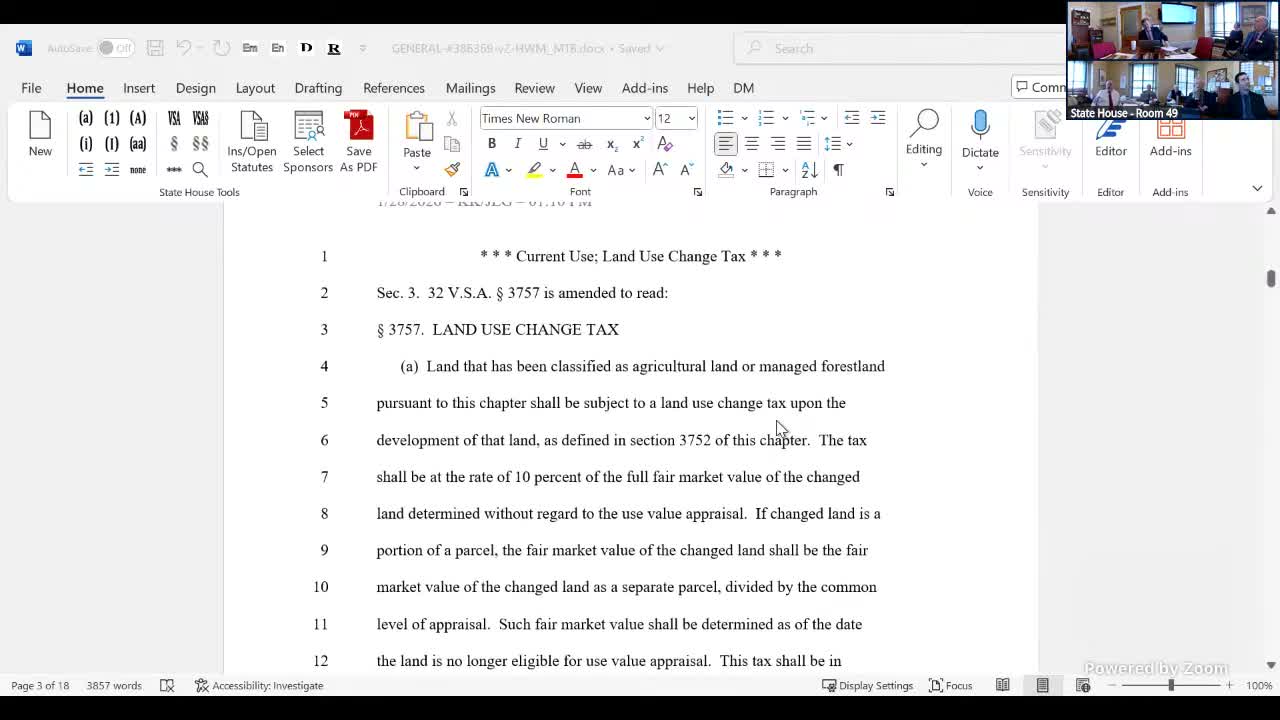
Summary
The committee examined Department of Taxes proposals to (1) require local assessing officials to value parcels within 30 days and let Property Valuation and Review (PVR) step in if they cannot; (2) adjust revenue sharing when the state performs valuations; and (3) allow grazing-rights income to help small parcels qualify for current-use enrollment.
Legislative counsel Kirby, who handles the tax portfolio for the committee, outlined Department of Taxes proposals that would change how the state and municipalities handle current-use parcel valuations and appeals. Kirby told the committee the bill would set a 30-day deadline for a local assessing official to determine fair-market value when a portion of a parcel is removed from current-use; "if they cannot do it in 30 days, then PVR has the ability to come in and do it," he said.
The department would also give PVR 30 days to value the parcel after stepping in, Kirby said. He described the measure as a procedural fix to address delays caused by municipal staffing shortages and to reduce the period when landowners do not know what land use change tax they will owe.
The proposal would change how revenue is distributed when the state performs the valuation. Currently, municipalities may retain up to $2,000 of the land use change tax to cover related work; the Department of Taxes proposes that if PVR performs the valuation and the state therefore retains the municipality's share, that revenue would be split as it is now between the education fund and the general fund (three-quarters to the education fund, one-quarter to the general fund), rather than being paid to the municipality.
Kirby said the change is meant to be a backstop when municipalities cannot meet the valuation deadline, not a replacement for local involvement. "Previously, when Jill testified on this in ways, she did mention that this doesn't mean that the department doesn't want to work with the municipality if they're struggling to get it done in time," he said.
Committee members asked why municipalities would not receive some offset when local values cause local revenue loss. Member Richard asked whether a portion should "go back to the municipality and offset their local taxes," noting municipalities also lose taxable value when property exits current-use assessment.
Appeals process and timing: the bill would make an appeal filed to the Department of Taxes count as timely even if the landowner intended to appeal to the municipality, Kirby said, and would lengthen the landowner's appeal window in this pathway. "Under current law, it is 14 days," he said, adding that expanding that to 30 days is intended to provide more due process time for mail delays and for property owners to seek professional advice.
Small-parcel eligibility: the Department is proposing to broaden the ways parcels under 25 acres can qualify for current-use. Kirby explained that, in addition to crop production and leases to farmers, the department would add grazing-rights income measured on a per-head basis as a qualifying activity. The bill would rely on an annual gross-income test (commonly cited in the discussion as $2,000) for the owner to enroll under the sub-25-acre pathway. "So it could be grazing rights plus farm income from something else to get you to that $2,000," Kirby said.
Members and participants raised questions about how the grazing-language would operate in practice and whether other small-scale activities—such as sugarbush (maple syrup production) or apiary arrangements—would count. Kirby affirmed that sugarbush is treated as a farm crop and said the $2,000 test can be demonstrated over a multi-year period if needed.
Next steps: the chair said the committee would resume discussion in the afternoon and that staff and PVR representatives would provide further detail and rationale at that time. No formal motion or vote was recorded in this session.