Get Full Government Meeting Transcripts, Videos, & Alerts Forever!
Get email alerts on the Cscrm Project topic
No spam. Unsubscribe anytime.
Collective serious‑crimes response model 57% complete; training items pushed to 2027, project management funded through FY26
Summary
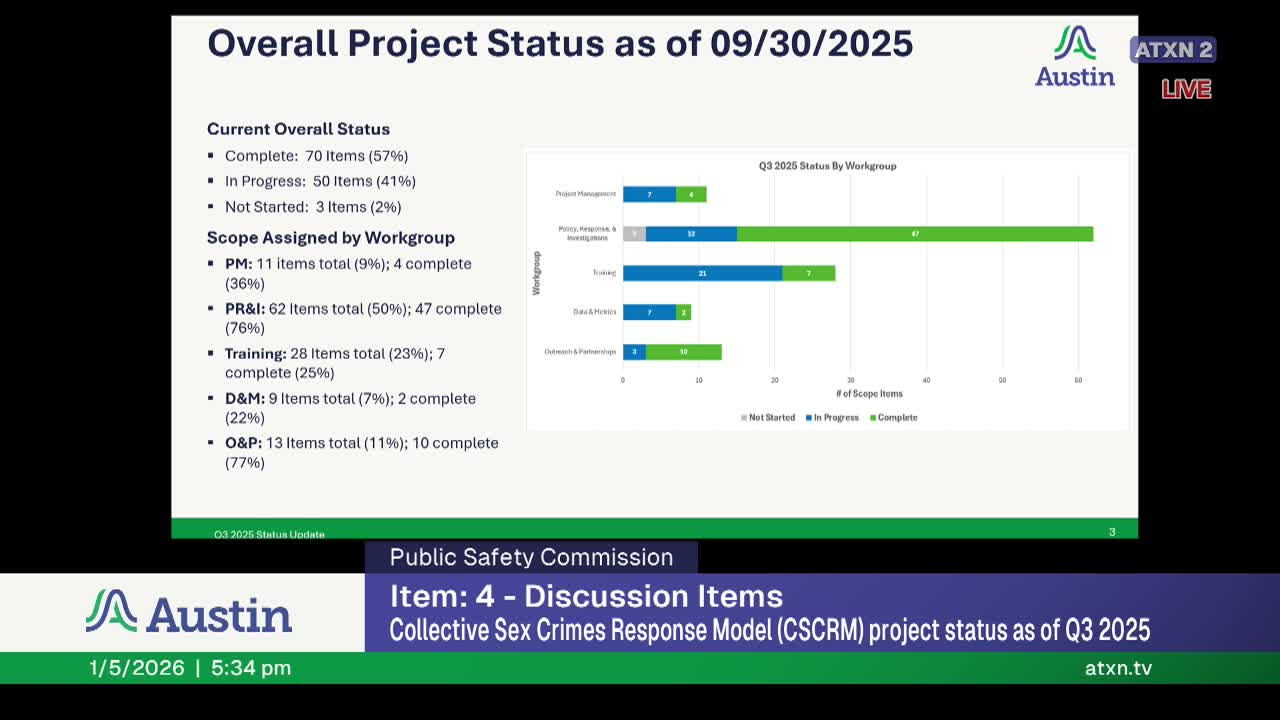
Staff said the Collective Serious Crimes Response Model project is roughly 57% complete, with 53 items remaining; 21 training items were deferred to 2027 to align with an overlapping federal grant and project management was funded for FY26 though staff warned some staffing and forensic exam capacity risks remain.
Project staff told the Public Safety Commission on Jan. 5 that the Collective Serious Crimes Response Model (CSCRM) workstream is roughly 57% complete and that much of the remaining work is training and staffing related.
"We are at 57% completion," said a project brief, noting nine items completed last quarter and 53 remaining. Staff said 15 items are targeted for the coming quarter, 17 were deferred to 2026 and 21 training‑related items were intentionally moved to 2027 to bundle them with a federal Abby Arnold grant that shares overlapping scope.
Independent project manager Hannah Senko, who has worked on the effort for about two and a half years, said most FY26 funding requests were met, including a project management position. "All of our requests for FY26 have been met," Senko said, while noting that some items later in the schedule may still require additional project management into FY27.
Staff flagged ongoing risks: a complex training curriculum, staffing and cultural issues across organizations, potential federal funding uncertainty and local forensic‑exam capacity. Commissioners urged attention to the timeline and asked about whether the public‑facing data dashboard would be released; project staff said the target is a Q1 rollout of the dashboard once data‑cleaning tasks are complete.
Commissioners expressed continued interest in budget planning for remaining items, in ensuring training milestones are funded and in the forensic exam capacity that could affect survivors' access to care. The project update was informational; commissioners will consider whether additional budget requests are needed in upcoming fiscal planning.