Get Full Government Meeting Transcripts, Videos, & Alerts Forever!
Get email alerts on the Counsel At First Appearance topic
No spam. Unsubscribe anytime.
Travis County officials and partners describe expansion of counsel‑at‑first‑appearance program; case management aims to reduce jail time
Summary
Representatives from Travis County public defense agencies told the Public Safety Commission that the county's counsel‑at‑first‑appearance program now operates daily with multiple providers, integrated case management and early indications that it helps identify housing and treatment options that increase judges' confidence to release people on personal recognizance.
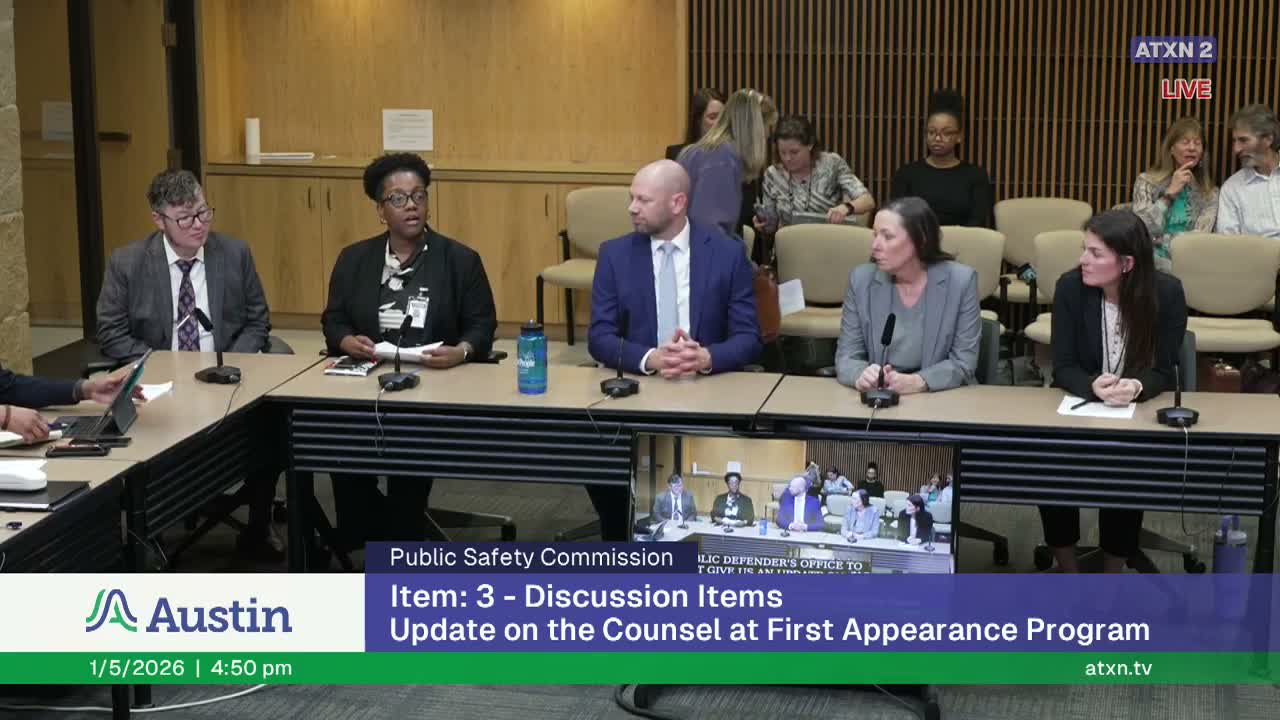
Travis County public defender leaders and partner organizations briefed the Public Safety Commission on Jan. 5 about an expanded council‑at‑first‑appearance program that provides early legal representation and on‑site case management at magistration.
"Council at first appearance is happening every day of the week, from 6 a.m. to 11 p.m.," Adeola Logan Kadeh, chief public defender, said, underscoring the program's daily hours. Kadeh said the public defender's office staffs roughly a quarter of those shifts; the new Office of First Defense handles about half of shifts and the Capital Area Private Defender Service covers roughly the remaining quarter.
Speakers credited the multi‑provider model and added case management services with improving outcomes. "Roughly 60% of the clients that our case management team met with during the month of December were unhoused," a CAPS case management representative said, and the case managers reported connecting dozens of clients to shelter, treatment and transportation resources in a single month (CAPS reported 43 clients given treatment referrals, 33 provided shelter options and 20 provided transportation in December case‑management contacts).
Kristen Jernigan, chief counsel for the Office of First Defense, said the program is designed for limited‑scope representation at bail hearings but coordinates with other providers to offer continuity of care. "We don't just represent them at the bail hearing," she said. "It's a holistic approach to people that are probably having one of the worst days of their life."
County leaders described system changes made to support the program: moving magistration from a basement room to a courtroom open to the public and creating on‑site interpretation and social services. Jeff Burkhart, county executive for community legal services, said the broader county effort represents a major investment and estimated annual county spending around $15 million to create and sustain the magistration overhaul.
Commissioners and presenters flagged staffing and compensation issues for defense providers and caseworkers and discussed the program's sustainability. Commissioners requested periodic updates with longer‑term outcome data (PR bonds issued, jail time averted) and recommended returning with an ETA for when the commission could review outcome differentials once more months of data are collected.
No formal action was taken; commissioners praised the collaboration among county offices, nonprofit partners and the private‑assigned counsel program and asked for ongoing reports on program metrics and sustainability.