Get email alerts on the Asset Management topic
No spam. Unsubscribe anytime.
Austin unveils RAMP: a proactive right‑of‑way maintenance plan and public mapping tool
Summary
City staff presented RAMP, the Right‑of‑Way Asset Management Plan for FY26, which prioritizes proactive maintenance across streets, signals, sidewalks and trees and includes a public-facing mapping tool planned for release in 2026; staff reported targets such as maintenance on 885 lane miles and preventive maintenance on about 1,254 signals and PHBs.
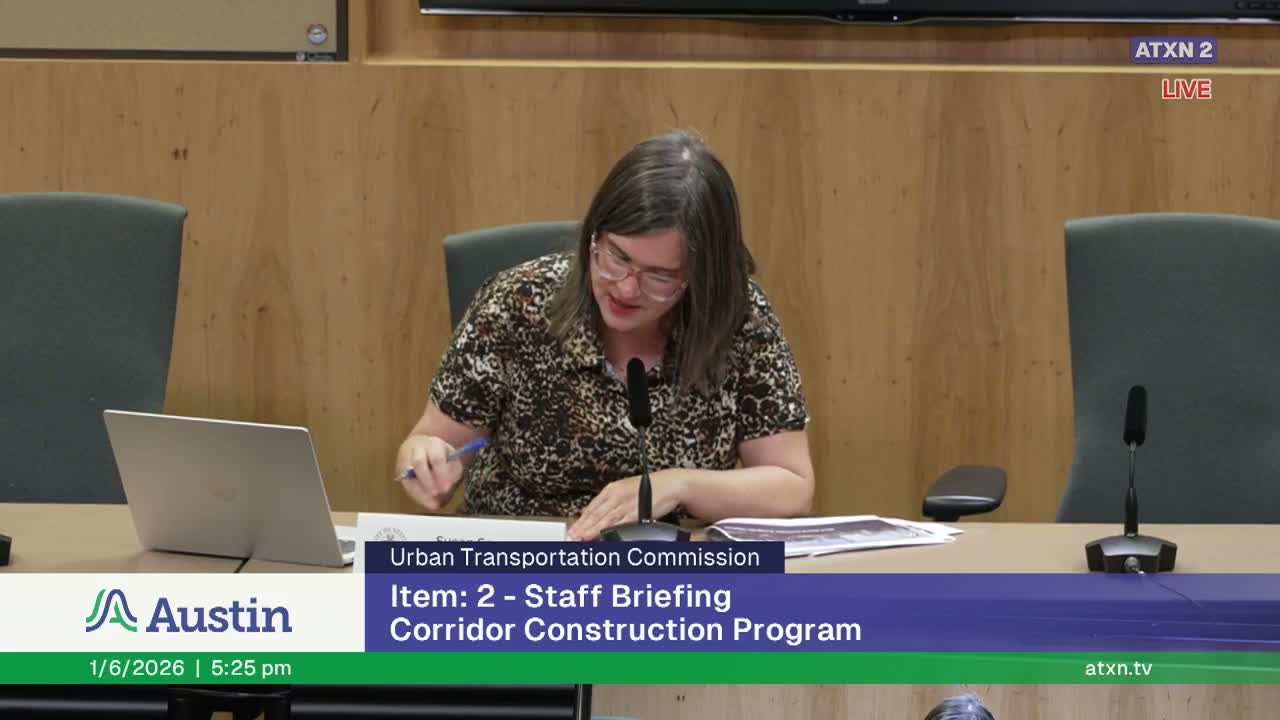
Austin Transportation and Public Works briefed the Urban and Transportation Commission on a new proactive maintenance program called the Right‑of‑Way Asset Management Plan (RAMP) and a companion interactive mapping tool. Adam Bailey, asset manager in the Office of the City Engineer, said RAMP organizes maintenance into three buckets—reactive response, capital projects, and proactive annual maintenance—and aims to extend asset life and reduce costly rehabilitation.
Bailey previewed a map‑based tool that can filter planned FY26 maintenance by council district and asset class. He said the department plans to maintain roughly 885 lane miles (about 10–11% of the network), perform preventive maintenance on approximately 1,254 signals and pedestrian hybrid beacons (PHBs), retime about one third of signals (roughly 400) each year, and inspect and clear about 46 miles of urban trails. For sidewalks the program lists about 5 miles of planned repairs (maintenance, not new installation). Bailey said the department maintains about 2,900 miles of sidewalks and that the city's accessibility goal for sidewalks is 80%; current condition sits near 40%.
Commissioners asked how 311 requests feed into RAMP priorities and whether the mapping tool would show completed work and 311 overlaps. Bailey said urgent 311 calls trigger reactive responses and that program teams use 311 data to investigate and, when appropriate, add items to the proactive plan. He confirmed the tool is Council-facing now and staff plan enhancements to make it public in calendar year 2026.
Other details included routine actions to reduce paid parking stations to better match usage, a plan to address 300 metal tree grates downtown and on West Campus, and ongoing signal preventive maintenance that includes equipment diagnostics and corridor synchronization. The city also plans to perform corridor-based signal retiming so every signal is touched on a three-year cycle.
The presentation emphasized that proactive maintenance investments are intended to delay more expensive rehabilitation and reconstruction, and staff said they will continue refining how the tool displays completed work and overlays with 311 calls.
AI generated
The text on this page is AI generated. Summaries, highlights, analysis, and video transcripts are all produced from the original source material.
AI can make mistakes, so if you spot one, and we will fix it for everyone.
Note: the source content is unaltered by us. Any content source we link to, be it a video, an audio recording, or a document, is presented exactly as its publisher released it. That publisher is usually a government body, sometimes an individual official or another organisation.