Get Full Government Meeting Transcripts, Videos, & Alerts Forever!
Get email alerts on the Infrastructure Corridors topic
No spam. Unsubscribe anytime.
City staff outlines progress, timelines and coordination challenges for 2016 Mobility Bond corridors
Summary
Austin staff reported roughly $360 million of 2016 Mobility Bond corridor work complete, $100 million leveraged from partners, and plans to move about $42 million into construction in 2026; South Lamar remains the largest, most complex corridor and may extend beyond the city's 2026 spending target.
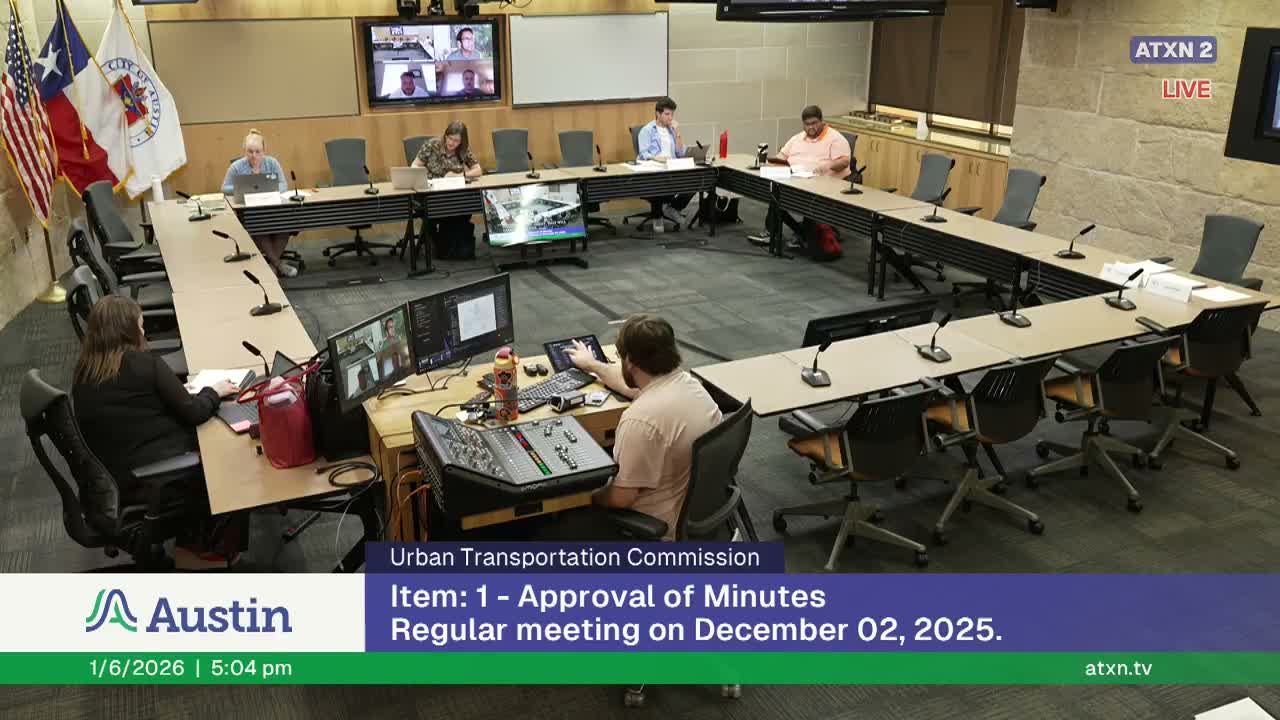
City staff on the Urban and Transportation Commission described progress and schedule risks across multiple corridors funded by Austin's 2016 Mobility Bond. Janae Landry, assistant director of Capital Delivery Services, told commissioners the program has "completed or achieved construction on about $360,000,000" and has "leveraged a $100,000,000 in additional funds" from grants, developers and partners, with an additional "$42,000,000 to construction" planned in 2026.
The presentation covered corridor-by-corridor updates. Landry said Airport Boulevard intersections and a shared-use path from North Lamar to 45th Street are finished, and that the City is coordinating with TxDOT on a bridge replacement and other work to accelerate local segments. For Burnet Road she reported intersection and drainage projects complete and contractors mobilizing on awarded segments to US 183 and Loop 1.
Several corridors remain in active construction or pending bids. East Riverside work and signal upgrades at Vargas and Frontier Valley are complete but some elements deferred due to Project Connect. East MLK and portions of North Lamar are being handed to TxDOT for construction; Landry said MLK plans are "at 90%" and currently programmed by TxDOT to start in March 2028, noting utility relocations and TxDOT budget and scheduling choices drove that timing.
South Lamar drew particular attention. Landry called South Lamar the program's "largest and kind of most complex corridor," describing a plan to split it into two bid packages and move in phases. She said the corridor represents roughly a $50,000,000 investment and that the entire corridor could have a six‑year construction timeline; the city aims to obligate money this year for the first segment and to apply lessons learned to a later phase.
Commissioners asked about the program's spending target and how coordination with state agencies affects delivery. Landry said the goal is to reach about 90% spent by 2026 but acknowledged South Lamar may lag that mark. She also explained the city's use of IDIQ (indefinite delivery/indefinite quantity) contracts for signal, sidewalk and shared‑use path work and said IDIQs are not suited for curb‑to‑curb reconstruction, which affects whether the city can directly build some TxDOT‑administered segments.
Landry provided a short list of near‑term milestones including final paving on West Mary and Evergreen, ongoing construction on Slaughter Lane and William Cannon (with an estimated wrap in October this year for the Running Water to McKinney Falls segment), and forthcoming bids for Burnett Road and other packages. She said bid packages for South Lamar's southern portion should be advertised in spring 2026.
The briefing closed with commissioners thanking staff for an overview of schedule and constraints; no formal action was taken.