Get Full Government Meeting Transcripts, Videos, & Alerts Forever!
Get email alerts on the South Shore Pud topic
No spam. Unsubscribe anytime.
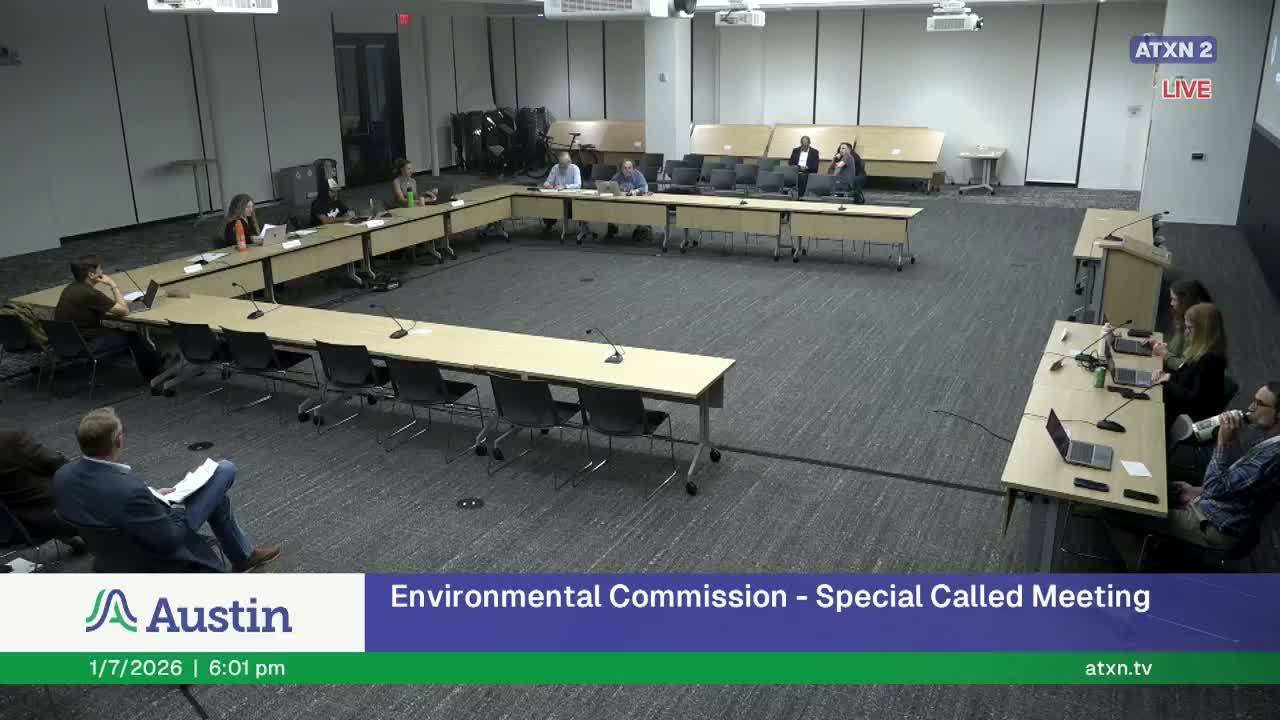
Environmental Commission debates 180‑foot South Shore PUD amendment; recommendation motion fails
Summary
At a Jan. 7, 2026, Austin Environmental Commission meeting, staff recommended approval of a South Shore PUD amendment (case C814‑2008‑0087.02) with environmental conditions including 3‑star green‑building and native plantings. Commissioners raised concerns about missing backup materials and impervious cover; a postponement failed and the commission’s recommendation motion did not pass.
The Austin Environmental Commission on Jan. 7, 2026, considered an amendment to the South Shore Planned Unit Development (case C814‑2008‑0087.02) that would add a 1.4‑acre parcel at East Riverside Drive and South Lakeshore Boulevard and allow a building up to 180 feet tall.
Shawn Watson of Austin Watershed Protection opened the public hearing and told commissioners that staff "recommends approval of the PUD with the following conditions," including that no additional environmental code modifications be allowed and that development comply with the City of Austin 2025 Green Building program at a three‑star level. Watson also noted the site contains a small critical water‑quality zone and no floodplain.
Applicant representative Michael Whelan described the proposal as a multifamily building (about 350 units, he said) and framed the height request as part of corridor densification in advance of future Austin light‑rail service adjacent to the Lakeshore Station. Whelan said the wet pond built under the original PUD was designed to treat runoff from this site.
Several commissioners pressed for missing documentation and more detail. Commissioner Breimer said the amendment file lacked the level of backup provided with the original PUD and argued the commission was being asked to "approve something with no back up data" and to vote on "a blank piece of paper." Breimer also noted the original PUD had included a maximum 120‑foot allowance that council later reduced to 90 feet near the river and questioned why the commission was now being asked to permit 180 feet.
The applicant and staff clarified some technical points in response: Whelan said the overall site‑wide impervious coverage would be "just below 77%" and described a proposed fee‑in‑lieu for affordable housing to the trust fund, which the applicant characterized as "well over" $1,000,000. Staff acknowledged a missing zoning/staff report in the meeting backup and apologized.
After discussion the commission closed the public hearing. Commissioner Sullivan moved that the commission recommend approval (Recommendation No. 20260701‑001) with the staff conditions and additional environmental commission conditions to "use native plantings to the maximum amount possible" and to "prioritize bird friendly design." Commissioner Qureshi seconded.
Commissioner Breimer moved a substitute motion to postpone the item until full documentation was available; that substitute motion was seconded and taken to a roll call but failed to reach the threshold identified in the meeting for passage. The commission then took a vote on the original recommendation motion; the motion did not obtain enough affirmative votes and failed. Staff later stated on the record that the item would "go forward with that without a motion," indicating the matter would proceed through the city process notwithstanding the commission vote.
The record shows commissioners split between advancing transit‑oriented density at this corridor and insisting on fuller documentation and clarity about the development program and mitigation measures before a recommendation is made. The commission also recorded support for environmental conditions such as native plantings and bird‑friendly design but did not reach a commission‑level recommendation on this amendment at the meeting.
What happens next: the PUD amendment remains in the city’s entitlement process; staff and the applicant indicated that site plans, architects’ documents and further details would follow in subsequent permitting steps.